Oct 7, 2026Services Overview
What Does PET Felt Panel Thickness Tolerance Actually Mean?
Learn what nominal thickness, actual thickness and thickness variation mean for PET felt panels, and what buyers should confirm before production.
What Does PET Felt Panel Thickness Tolerance Actually Mean?
When buying PET felt panels, customers often specify the thickness very simply.
For example:
12mm PET felt
But what does “12mm” actually mean?
Does every point of the sheet measure exactly 12mm?
Usually, this is not the right way to look at it.
For PET felt, it is more useful to understand the difference between nominal thickness, actual thickness and thickness variation.
This becomes especially important when the material will be used for CNC cutting, furniture components, acoustic panels or other applications where the material needs to fit with other parts.
Nominal Thickness Is the Specification
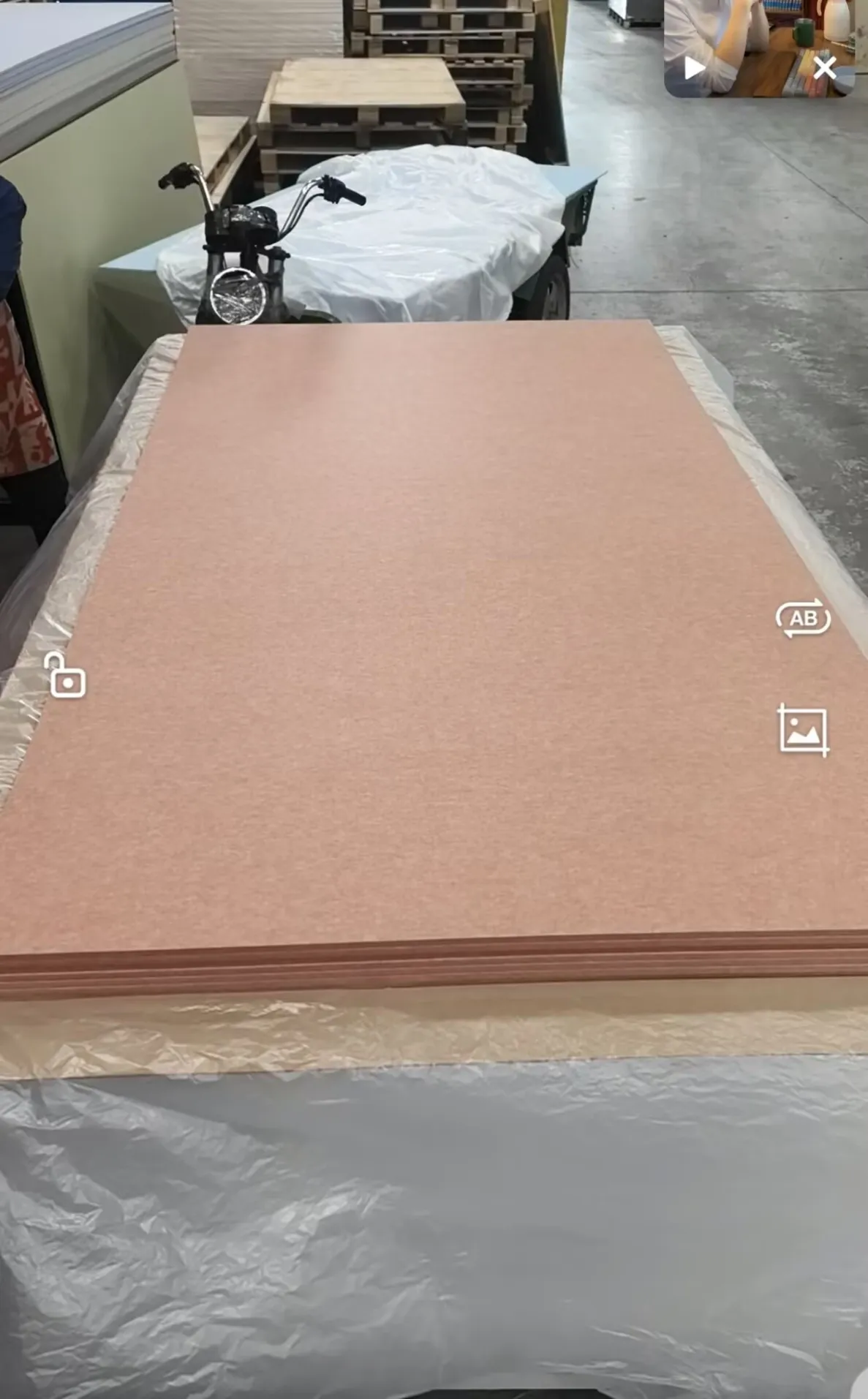
When we say a PET felt panel is 12mm, 18mm or 24mm, this is normally the nominal thickness.
It is the thickness used to define the product specification.
For example, a specification may say:
- 12mm PET felt
- 2400gsm
- 1220 × 2440mm
The 12mm here is the target thickness of the product, not a promise that every point on every sheet will measure exactly 12.00mm.
This is an important difference when discussing thickness tolerance with a supplier.
Actual Thickness Is What You Measure
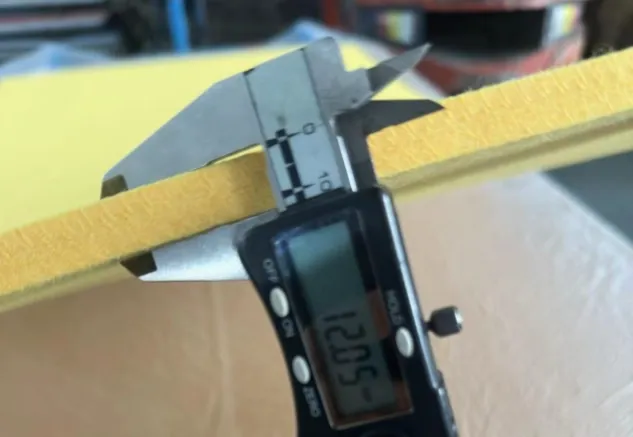
The actual thickness is the thickness measured on the physical panel.
If you take a 12mm PET felt sheet and measure different points, the readings may not all be exactly the same.
This is normal for a fibrous material.
PET felt is made from polyester fibres that are bonded and compressed during production. Its thickness can therefore be affected by the material structure, density, compression and measurement condition.
For this reason, when thickness is important for your application, it is better to discuss how the thickness is measured, rather than only asking:
“Is it 12mm?”
How Much Thickness Tolerance Should You Expect?
This is where a clear supplier specification becomes useful.
In our production, we control PET felt thickness tolerance within ±0.5mm, and for some production conditions, the variation can be controlled to around ±0.3mm.
This means that when we discuss a 12mm PET felt panel, we are not only looking at the nominal number. We also pay attention to how consistently the material is produced across the sheet and from batch to batch.
Of course, the actual tolerance requirement can depend on the product specification and application.
For customers using PET felt for CNC cutting or components that need to fit with other materials, tighter and more consistent thickness can make the production process easier.
Thickness Can Vary Across One Sheet
Another useful question is:
How much can the thickness vary across one sheet?
For example, the thickness near the centre of a panel may not be exactly the same as at another position.
This does not automatically mean the panel has a quality problem.
The more important question is whether the variation is within the agreed production requirement and whether it affects the customer's application.
Thickness control is therefore not the only dimensional point we pay attention to.
For our standard PET felt panels, we also control the sheet size tolerance within ±3mm and the diagonal tolerance within about 1–2cm.
These details may look small when buying raw material, but they can become more noticeable when the sheets are used for CNC cutting, nesting or further fabrication.

Batch-to-Batch Variation Also Matters
There is another type of variation that is easy to overlook.
It is the difference between different production batches.
A supplier may produce 12mm PET felt in one batch and another batch several weeks later. The nominal specification can still be 12mm, but the actual measurement may not be identical in every batch.
This is why customers with regular purchasing needs should not only confirm the nominal thickness.
It can also be useful to discuss the expected thickness tolerance and whether the same production specification will be maintained from batch to batch.
Density is another specification worth checking.
For our PET felt, the density tolerance is controlled from approximately -150g/m² to +300g/m² against the specified GSM.
For projects where several batches will be combined, consistency can be more important than one individual measurement.
What About Thickness After Hot Pressing?
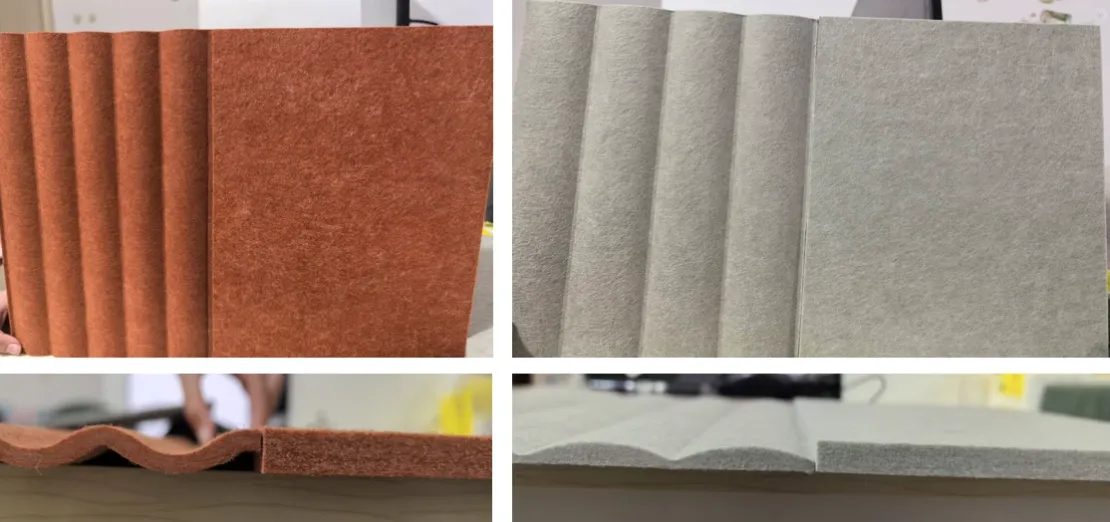
For some PET felt products, hot pressing or thermoforming is part of the manufacturing process.
In this situation, the material condition after processing may be different from the original flat sheet.
Pressure, heat and forming can affect the final shape and thickness in the processed area.
So if your final product will be hot pressed or thermoformed, it is better to confirm the thickness requirement for the finished condition, rather than only checking the original flat sheet.
The supplier should know what the material will be used for before confirming the suitable specification.
What About Thickness After CNC Processing?
CNC cutting itself does not normally mean that the whole panel becomes thinner.
However, the way the material is cut can affect the finished component, especially when the design includes grooves, steps, V-grooves or other machining details.
For a simple through-cut, the main concern may simply be the original panel thickness.
For a more complicated design, the customer and supplier should discuss the required dimensions of the finished part, not just the nominal thickness of the raw sheet.
This is one reason why sending the drawing together with the material requirement can be much more useful than asking for a thickness number alone.
What Should You Ask Your PET Felt Supplier?
If thickness is important for your project, I would suggest confirming these points:
- What is the nominal thickness?
- How is the actual thickness measured?
- What thickness tolerance is normally controlled?
- How much variation can occur across one sheet?
- How is thickness consistency controlled between production batches?
- What is the sheet size tolerance?
- Is there a diagonal tolerance requirement?
- What is the density tolerance?
- Is the requirement for the flat sheet or the finished product after processing?
- Will hot pressing, thermoforming or other processing affect the final thickness?
These questions give both sides a clearer understanding of what “12mm PET felt” actually means.
Thickness Is Only One Part of the Material Specification
For example, two PET felt panels can both be described as 12mm, but their GSM, density, hardness or internal bonding may be different.
This can affect how the material behaves during CNC cutting and other processing.
So when comparing PET felt from different suppliers, it is better to look at the complete material specification instead of comparing the thickness number alone.
For us, tolerance control is part of the material quality, not just a number on a specification sheet.
The purpose is simple: to give customers a more consistent material for their next processing step and reduce unnecessary problems during production.
If you are sourcing PET felt for CNC cutting, furniture production or acoustic applications, send us your required thickness, GSM and application. If you have a drawing or specific tolerance requirement, you can send that as well, and we can check the material specification with you before production.
More related pages:
📩 Send us your project drawings or specifications, and we will respond with a clear quotation and production suggestion within 24 hours.
Email: info@hengmy.com