Sep 30, 2026Services Overview
Why Thicker PET Felt Needs More Than Weight
When choosing thicker PET felt, gsm alone is not enough. Learn how thickness, density, fiber bonding and processing affect material stability, CNC cutting and production consistency.

Why Thicker PET Felt Needs More Than Weight
When buying PET acoustic felt, it is common to compare products by two simple numbers: thickness and gsm.
For example, a buyer may think:
“If I need a thicker panel, can we just keep the density lower to reduce the weight and cost?”
It sounds reasonable. But for thicker PET felt, the answer is not always that simple.
When the thickness increases, the manufacturer needs to consider not only how much fiber is used, but also how the fibers are bonded and how stable the material remains through the full thickness.
This is particularly important when the PET felt will later be CNC cut, thermoformed or used for larger acoustic panels.

Thickness and density are connected
PET felt is made by forming and bonding polyester fibers into a sheet. The final material depends on several factors, including fiber structure, bonding, thickness, density and the production process.
When a sheet becomes thicker, simply adding or reducing fiber does not tell the whole story.
If the density is too low for the required thickness and application, the panel may become too soft or less stable during handling and further processing. For some constructions, insufficient internal bonding can also create separation or weakness within the sheet.
This is why a density that works well for a thinner panel may not necessarily be suitable for a much thicker one.
The question is not only:
“Can this thickness and gsm be produced?”
A more useful question is:
“Can this specification be produced consistently while maintaining the required structure and processing performance?”
Why the lowest gsm is not always the best choice
A lower gsm can look attractive on a quotation because it uses less material and may reduce the unit cost.
But a lower number is not automatically a better specification.
For thicker PET felt, buyers should also consider:
- structural stability
- hardness and handling
- CNC cutting performance
- surface quality
- dimensional stability
- thermoforming requirements
- final installation method
For example, a panel that is too soft may not give the same cutting result as a firmer material, even when the thickness and design are the same.
This becomes more noticeable when the material is processed in larger quantities.
What happens during thicker PET felt production?
Thicker sheets require the manufacturer to pay closer attention to the internal fiber structure and bonding.
The production settings need to be suitable for the thickness and target density. The goal is not simply to make the panel heavier. It is to achieve a stable material with a suitable balance between thickness, density, hardness and fiber bonding.
There is also an important difference between producing one sample and producing hundreds or thousands of sheets.
A specification may look acceptable in a sample, but the real test is whether the same structure, hardness and surface quality can be maintained throughout larger production quantities.
This is why experienced suppliers may sometimes recommend a higher density than the original target.
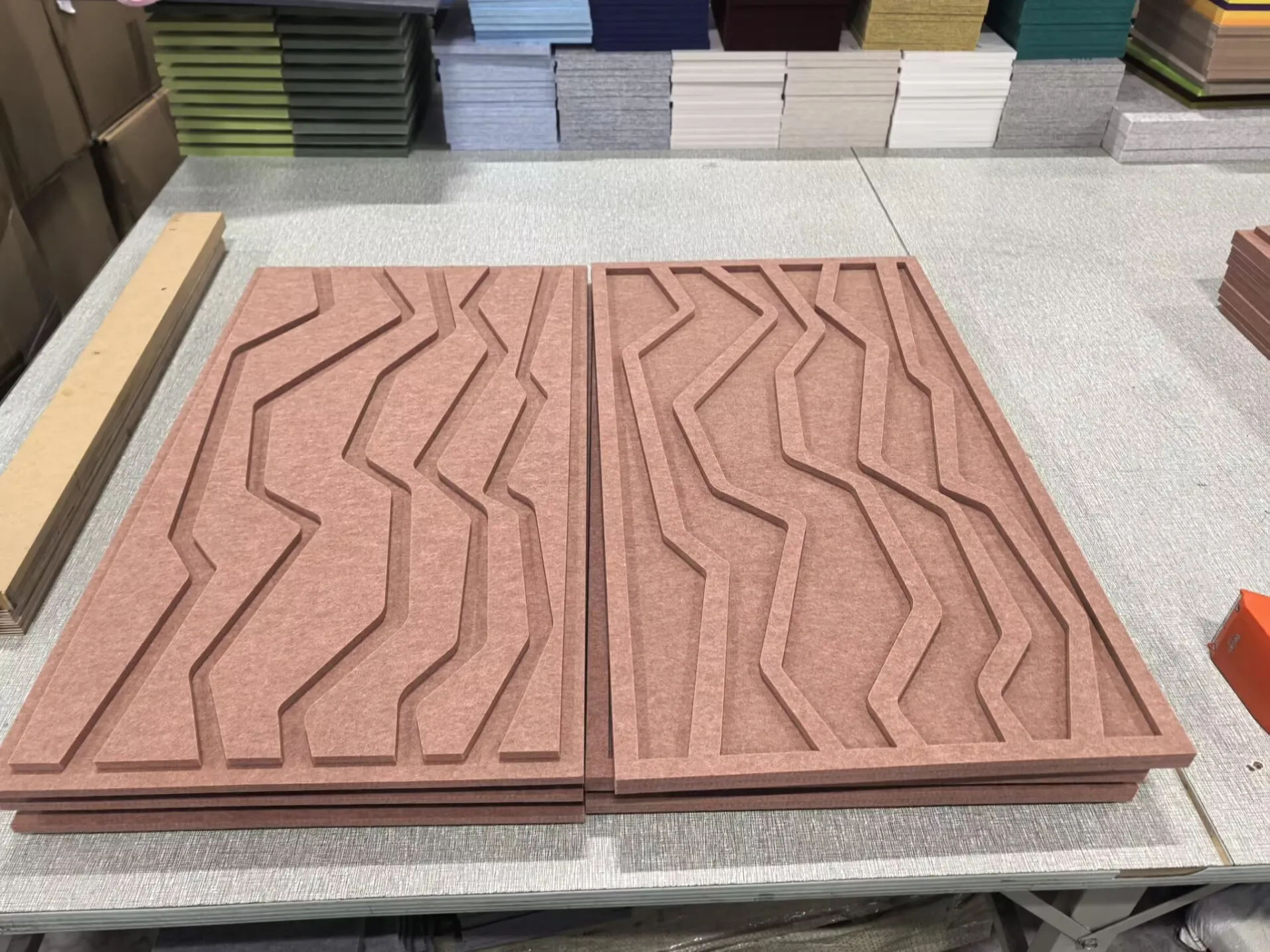
A practical example: 18mm and 20mm PET felt
For certain 18mm and 20mm applications, a customer may initially request a lower gsm because they want to reduce material cost.
However, if the panels will be CNC cut or further processed, a higher density can sometimes provide a better balance between structure, hardness and processing performance.
For some applications, 3300gsm can be a suitable option for 18mm or 20mm PET felt.
This does not mean 3300gsm is the correct specification for every 18mm or 20mm panel.
The right density depends on the production process, application and required processing performance.
That is why it is better to evaluate the specification as a whole instead of selecting gsm from a price comparison alone.
What should you ask your PET felt supplier?
If you are comparing different PET felt suppliers, gsm is only one question to ask.
It is also useful to ask:
How is the material bonded through the thickness?
Is this density a stable production specification?
How does the material perform during CNC cutting or other processing?
Can the same specification be maintained in larger production quantities?
These questions can help identify differences that may not be visible on a quotation sheet.
A good PET felt specification is not necessarily the lightest or the cheapest one.
It should provide the right balance between thickness, density, internal structure, processing performance and cost for the intended application.
If you are developing an 18mm, 20mm or 24mm PET felt application and are not sure which density is suitable, send us your required thickness, sheet size, target gsm and application.
We can check the production feasibility with our team before you place the order and help you choose a specification that is practical for the final application.
More related pages:
📩 Send us your project drawings or specifications, and we will respond with a clear quotation and production suggestion within 24 hours.
Email: info@hengmy.com