Oct 13, 2026Services Overview
Do Office Desk Screens Need Multi-Layer PET Felt?
Explore how single-layer PET felt works for office desk screens, including rigidity, sound absorption, pinboard use, thickness, density and production tolerances.
Do Office Desk Screens Need Multi-Layer PET Felt?
Do Office Desk Screens Need Multi-Layer PET Felt?
When designing office desk screens, the material may need to do several jobs at the same time.
It should have enough rigidity to work as a screen, help absorb sound in the office, and ideally allow users to pin notes or documents directly onto the surface.
One possible solution is a multi-layer construction, for example, a denser outer layer with a softer inner layer and another dense layer on the back.
But is this always necessary?
Not necessarily. For some office furniture applications, a single layer of PET felt can already meet several of these requirements.
Single-Layer PET Felt for Office Desk Screens
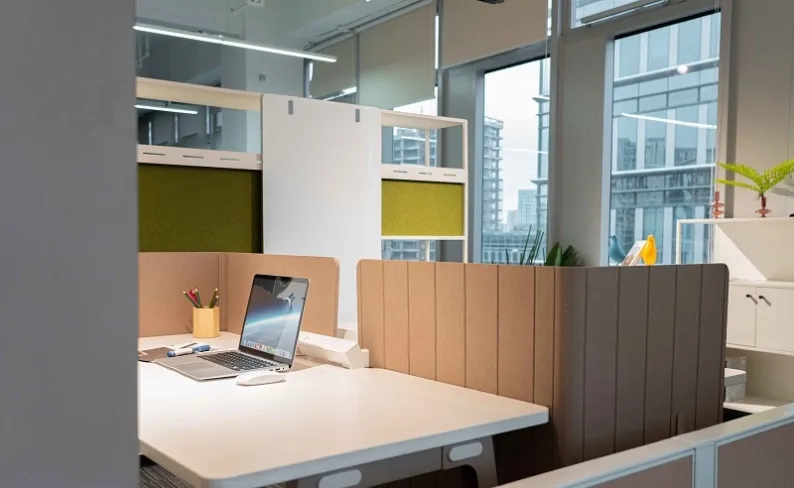
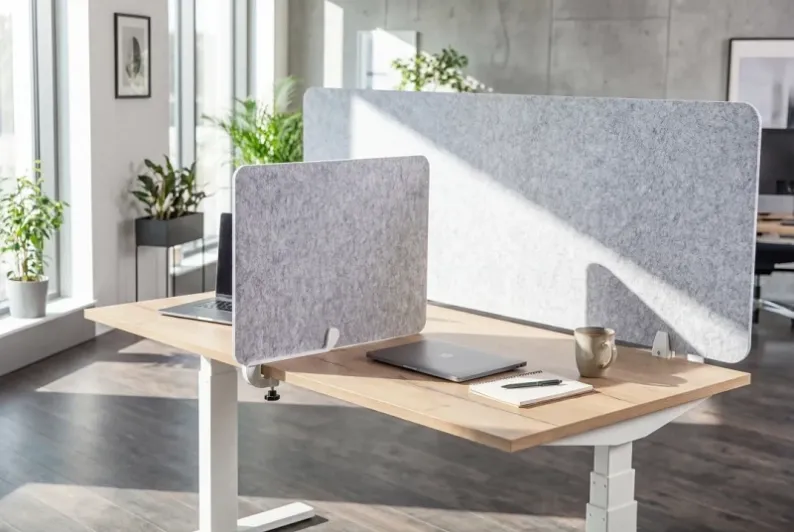
We work with office furniture applications where 12mm, 18mm and 24mm PET felt panels are used as desktop screens.
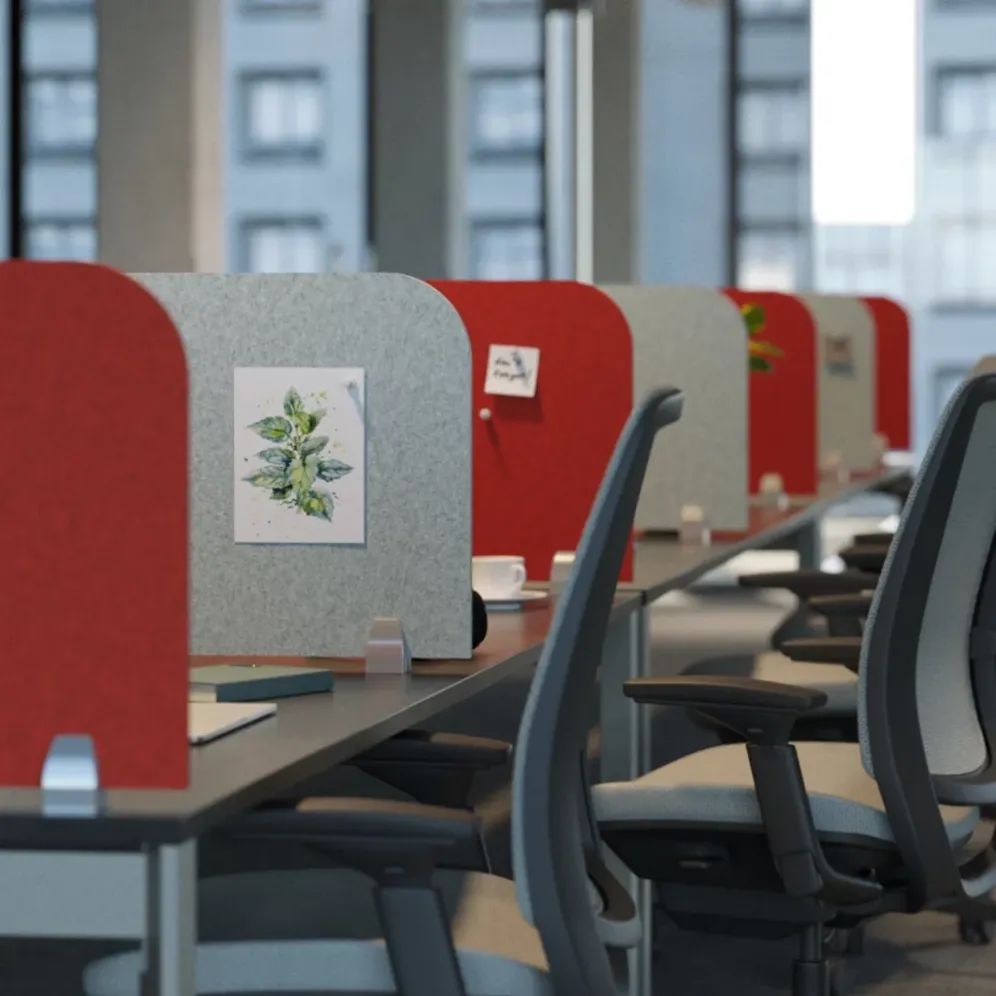
These screens use a single layer of PET felt rather than a laminated structure. They can also be used as pinboards, allowing users to pin notes and other lightweight documents directly onto the material.
For these applications, the available material specifications include:
Thickness | Areal weight |
|---|---|
12mm | 2400gsm |
18mm | 3000gsm or 3300gsm |
24mm | 3800gsm, 4000gsm or 4300gsm |
These are material options used in office screen applications, not a universal specification for every desk screen.
The right choice depends on the screen dimensions, how it is supported, and the requirements of the finished furniture.
For example, a screen fixed securely to a desk may have different requirements from a larger panel that needs to stand more independently.
Is Higher Density Always Better?
Not necessarily.
Areal weight, expressed in grams per square metre (gsm), tells you how much material there is per unit area. It is useful when comparing PET felt specifications, but it does not tell you everything about how the panel will perform.
Two panels with similar areal weights may not have exactly the same stiffness, surface feel or pinning performance.
For an office screen, I would look at several practical factors:
- Rigidity: Does the panel have enough stiffness for its dimensions and mounting method?
- Pinning performance: Can users insert and remove pins without the material becoming unsuitable for continued use?
- Sound absorption: Does the panel provide the required acoustic performance in the intended installation?
- Surface and edge quality: Can the material be cut and finished to the required dimensions without unacceptable defects?
These factors help determine whether a material is suitable for the actual application.
A heavier panel is not automatically the best choice. The goal is to find a specification that meets the requirements without adding material unnecessarily.
When Does Multi-Layer Construction Make Sense?
Multi-layer construction can be useful when different parts of the material need to perform different functions.
For example, a designer may want a firmer outer surface combined with a softer core. This could be worth investigating when the required combination of stiffness, pinning performance and acoustic properties cannot be achieved with a single layer.
However, adding layers also means there are more construction details to control.
The finished thickness, layer alignment, bonding consistency and flatness may all need to be checked. The bonding process and the materials used can also affect the result.
This does not mean multi-layer PET felt is inherently less consistent. It means the complete construction needs to be considered, rather than looking at the thickness or total weight alone.
If a multi-layer design is being developed, it is useful to agree on the required finished thickness, acceptable variation, flatness and layer structure before moving into production.
A sample should then be checked against these requirements.
How Should Production Tolerance Be Evaluated?
For office furniture manufacturers, consistency between batches is often just as important as the initial material selection.
A panel may look suitable during the first sample review, but the specification also needs to remain consistent when the material is produced in larger quantities.
For single-layer PET felt, thickness, areal weight and sheet dimensions are useful parameters to specify.
For multi-layer materials, it is also important to consider the finished construction, including the thickness of the complete panel and the consistency of the bonded layers.
There is no single tolerance value that applies to every PET felt construction. The achievable tolerance depends on the material specification and manufacturing process.
For this reason, I recommend discussing the required tolerance with the material supplier before confirming the specification. If a particular thickness or dimensional tolerance is critical to your furniture design, it should be clearly defined and checked during sample approval and production.

What Is the Best Way to Choose a PET Felt Specification?
Start with the finished product rather than selecting a gsm value first.
Consider the screen dimensions, mounting method, required rigidity, pinboard use and acoustic requirements. Then compare suitable thicknesses and areal weights against these needs.
If a single-layer panel meets the requirements, a more complicated construction may not be necessary. If it does not, a multi-layer solution can be evaluated against clearly defined performance targets.
We supply PET felt sheets in different thicknesses and areal weights for office furniture and other applications. We can help you review the material options based on your intended use, dimensions and processing requirements.
Developing a new office desk screen?
Send us your required thickness, panel dimensions and intended application. If you are considering a multi-layer construction, let us know which properties you need to improve.
We can review the available PET felt specifications with you and help identify a suitable starting point for sampling and further evaluation.
Contact us to discuss your project.
More related pages:
📩 Send us your project drawings or specifications, and we will respond with a clear quotation and production suggestion within 24 hours.
Email: info@hengmy.com