Aug 21, 2026Services Overview
How to Choose PET Felt Panel Density
Learn how to choose the right PET felt panel density based on acoustic applications, CNC processing, surface requirements, and cost considerations.
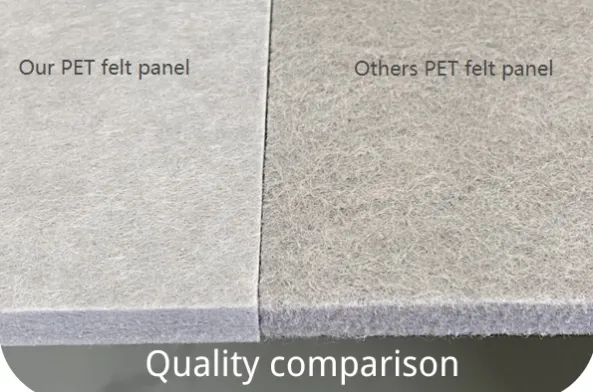
How to Choose PET Felt Panel Density for Acoustic Applications
When purchasing PET felt acoustic panels, one question often comes up:
"Is higher density always better?"
Many customers believe that a higher density PET felt panel means better quality.
This idea is understandable.
Higher density usually means:
- harder surface
- stronger structure
- heavier material weight
However, in real acoustic panel production, the highest density is not always the best choice.
The right PET felt panel depends on:
- application
- processing method
- installation requirements
- cost expectations
Choosing the correct specification is more important than simply choosing the highest GSM.
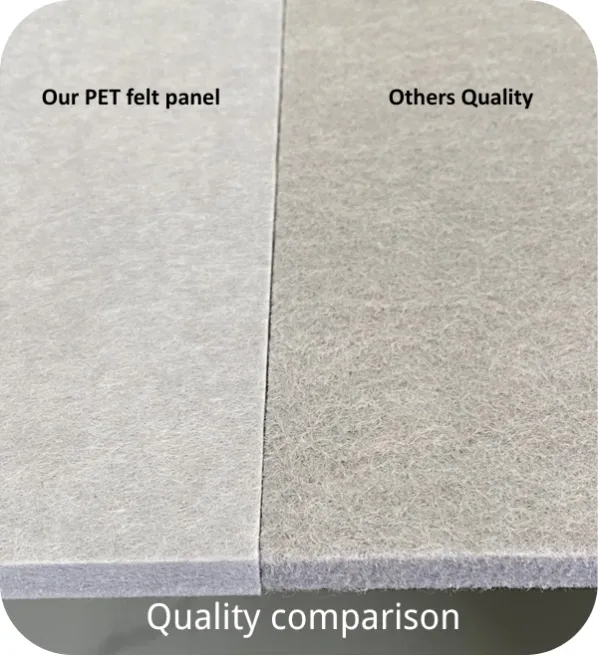
What does PET felt density mean?
PET felt density is usually measured by GSM (grams per square meter).
For example:
- 1800 GSM
- 2000 GSM
- 2400 GSM
- 2600 GSM
A higher GSM means more PET fiber material is used in the same area.
Generally, higher density can provide:
- better rigidity
- stronger surface structure
- improved dimensional stability
But it also means:
- higher material cost
- different cutting performance
- different processing characteristics
Therefore, density selection should always be connected with the final application.
Different densities can work for different applications
For a 12mm PET felt panel, different densities can be suitable depending on the customer's requirements.
For example:
Lower density PET felt panels
Lower density panels can be suitable when customers focus on:
- cost control
- lightweight applications
- basic acoustic functions
They may also be suitable for some products where the PET felt panel is used as a backing material.
Medium density PET felt panels
Around 2400 GSM has become a popular choice for many professional users.
Especially for:
- wooden slat acoustic panel manufacturers
- office furniture producers
- acoustic product brands
- interior material suppliers
The reason is balance.
2400 GSM usually provides:
- enough hardness
- good CNC cutting performance
- stable shape
- clean cutting edges
- reasonable material cost
For many applications, this balance is more important than choosing the highest density.
Higher density PET felt panels
Higher density panels can be useful for projects requiring:
- stronger structure
- special CNC designs
- more rigid finished products
However, higher density does not automatically improve every final product.
For example:
If PET felt is used only as the backing layer of a wooden slat acoustic panel, an extremely high density may increase cost without creating significant additional value.
Density selection depends on processing method
PET felt panels are often used as raw materials for further processing.
Different processes may require different material characteristics.
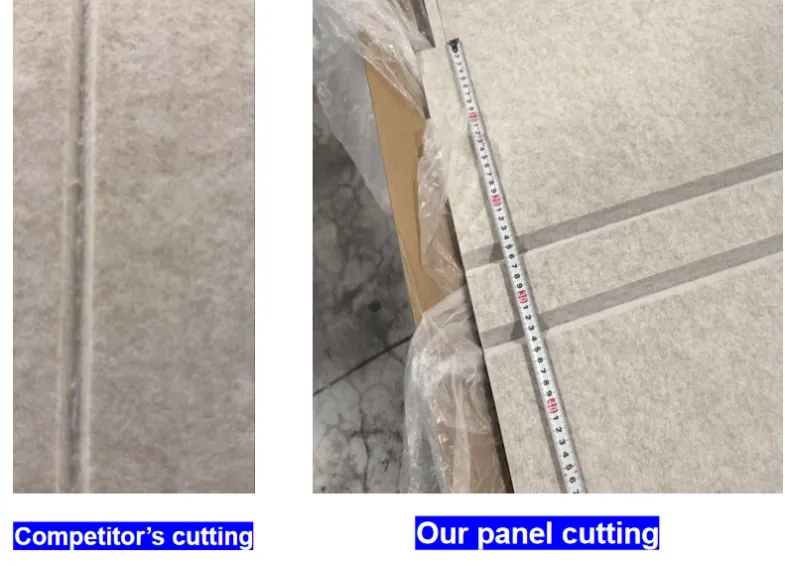
CNC cutting applications
For CNC cutting, customers usually need:
- stable material structure
- clean edges
- accurate dimensions
A suitable density helps achieve better processing results.
However, the highest density is not always necessary.
The best choice depends on the design complexity and production requirements.
Printed PET felt panels
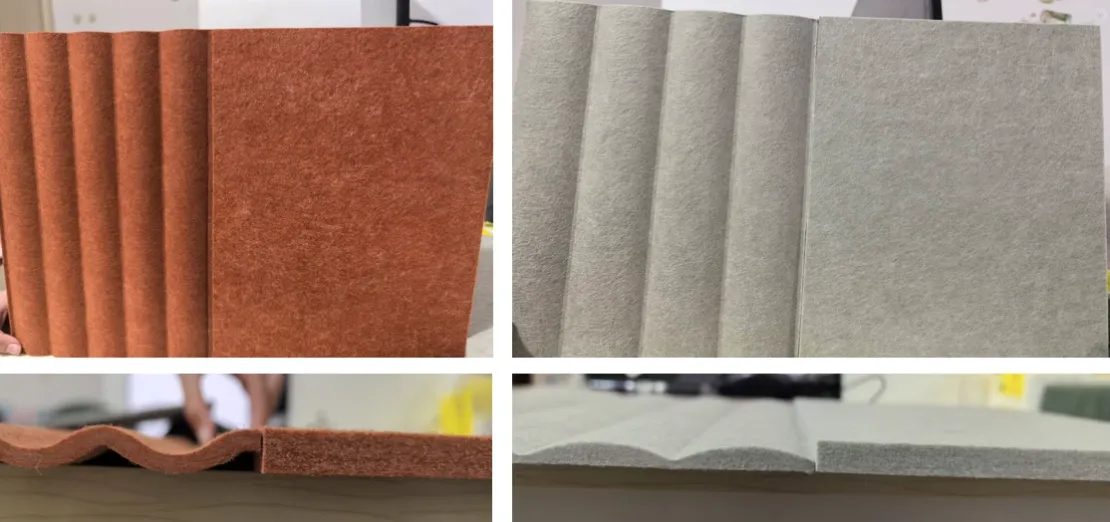
For printed PET felt products, surface quality becomes very important.
Some customers choose an additional hot pressing process after panel production.
Hot pressing can:
- make the surface smoother
- reduce loose fibers
- improve printing results
- increase surface hardness
For example:
A standard 9mm PET felt panel can often be pressed into around 6mm.
A standard 12mm panel can often be pressed into around 9-10mm.
After hot pressing, the surface quality improves.
However, there are also changes:
- thickness decreases
- acoustic performance may slightly change
This is why material selection should always consider the final purpose.
A professional supplier should recommend, not only quote
When customers ask for PET felt panels, some suppliers only provide:
"Here is our price."
But choosing the correct material requires more discussion.
A reliable manufacturer should ask:
- What is the final application?
- Will the panel be CNC cut?
- Will it be printed?
- Will it be installed directly?
- Is cost control important for this project?
Because the same PET felt panel can perform differently in different applications.
The right material is better than the most expensive material
In acoustic panel manufacturing, higher density does not automatically mean better quality.
The best PET felt panel is the one that provides the right balance between:
- performance
- processing ability
- appearance
- cost
A professional supplier should help customers select the most suitable specification instead of simply recommending the highest-priced option.
Because in real projects:
The right material always creates better results than the most expensive material.
Looking for the right PET felt panel specification for your acoustic project?
Contact us and we can help you evaluate the suitable density, thickness, and processing options based on your application.
More related pages:
📩 Send us your project drawings or specifications, and we will respond with a clear quotation and production suggestion within 24 hours.
Email: info@hengmy.com