Jun 26, 2026News & Insights
PET Felt CNC Cutting Problems – Flaking & Burr Solutions for Furniture
Struggling with PET felt panels flaking or burrs during CNC or V-groove cutting? Learn why GSM alone is not enough and get high-hardness test samples for reliable results.
Why PET Felt Panels Flake After CNC Cutting (And How to Fix It)
A client recently reached out:
“Some projects we do V-groove cut on the PET panels… We faced quality issues in the middle part — small flakes after cutting. Our tech says 2500 gsm may avoid this issue, but current panels are 2400 gsm.”
If you are doing V-groove cutting or deep CNC processing on PET felt panels, you probably recognize this situation immediately.
This is one of the most common production problems for office furniture manufacturers and acoustic product brands.
Many technicians believe:
“Maybe we should use 2500 gsm instead of 2400 gsm.”
But in most cases, GSM alone is not the real solution.
Let’s break down what is really happening.
The Real Reason PET Felt Panels Flake During CNC Cutting
From practical production experience, flaking usually happens because of one (or both) of these reasons:
1️⃣ Actual Density Is Lower Than Declared
Many panels are sold as 2400 gsm.
But when tested, actual density may be closer to 1800–1900 gsm.
Lower density means:
- Fibers are not compressed tightly
- Internal bonding is weaker
- Structure is softer
- CNC tool pulls fibers instead of slicing cleanly
Under high-speed rotation, the panel tears instead of cuts.
Result: flakes and fuzz.
The buyer believes it is 2400 gsm.
But performance tells the truth.
2️⃣ Same GSM Does Not Mean Same Hardness
This is something many buyers don’t realize.
Two panels can both be 2400 gsm.
But:
- Different hot-press temperature
- Different pressure level
- Different fiber blend ratio
- Different needling process
Will result in:
- Different surface hardness
- Different compactness
- Different cutting behavior
If production control is not stable, even 2500 gsm or 2600 gsm may still flake.
Because the internal bonding strength is not optimized.
Density without proper compression does not solve machining problems.
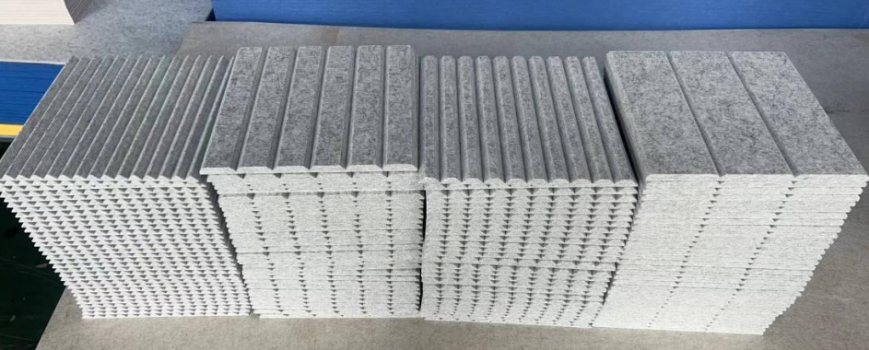
What Actually Works for CNC & V-Groove Processing
For clients who require:
- V-groove folding panels
- CNC bevel cutting
- Deep slotting
- Acoustic furniture components
- Partition systems
We recommend:
✔ Real Tested Density ≥ 2400 gsm
(not declared value — real measured value)
✔ High Hardness Production Line
(stable compression & fiber bonding)
✔ Batch-to-Batch Consistency
High hardness panels provide:
- Clean cutting surface
- No middle-layer flaking
- No burrs
- Smooth cross section
- No internal separation
For furniture manufacturers, this directly affects finished product quality and brand value.
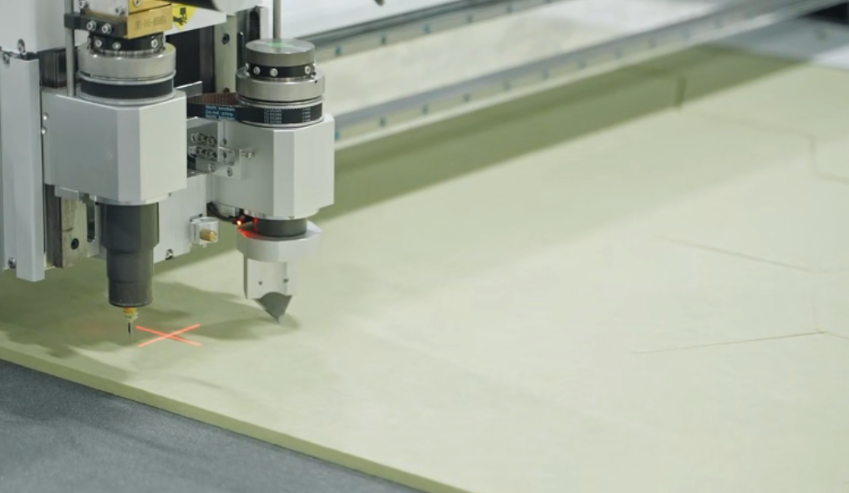
Machine Parameters Also Matter
To be realistic, material is not the only factor.
CNC performance is influenced by:
- Spindle speed
- Feed rate
- Tool sharpness
- Tool geometry
- Operator experience
However:
A stable high-hardness PET felt panel gives you a much wider processing tolerance window.
This means:
- More consistent results
- Less production risk
- Lower reject rate
- Better scalability
In mass production, stability is everything.
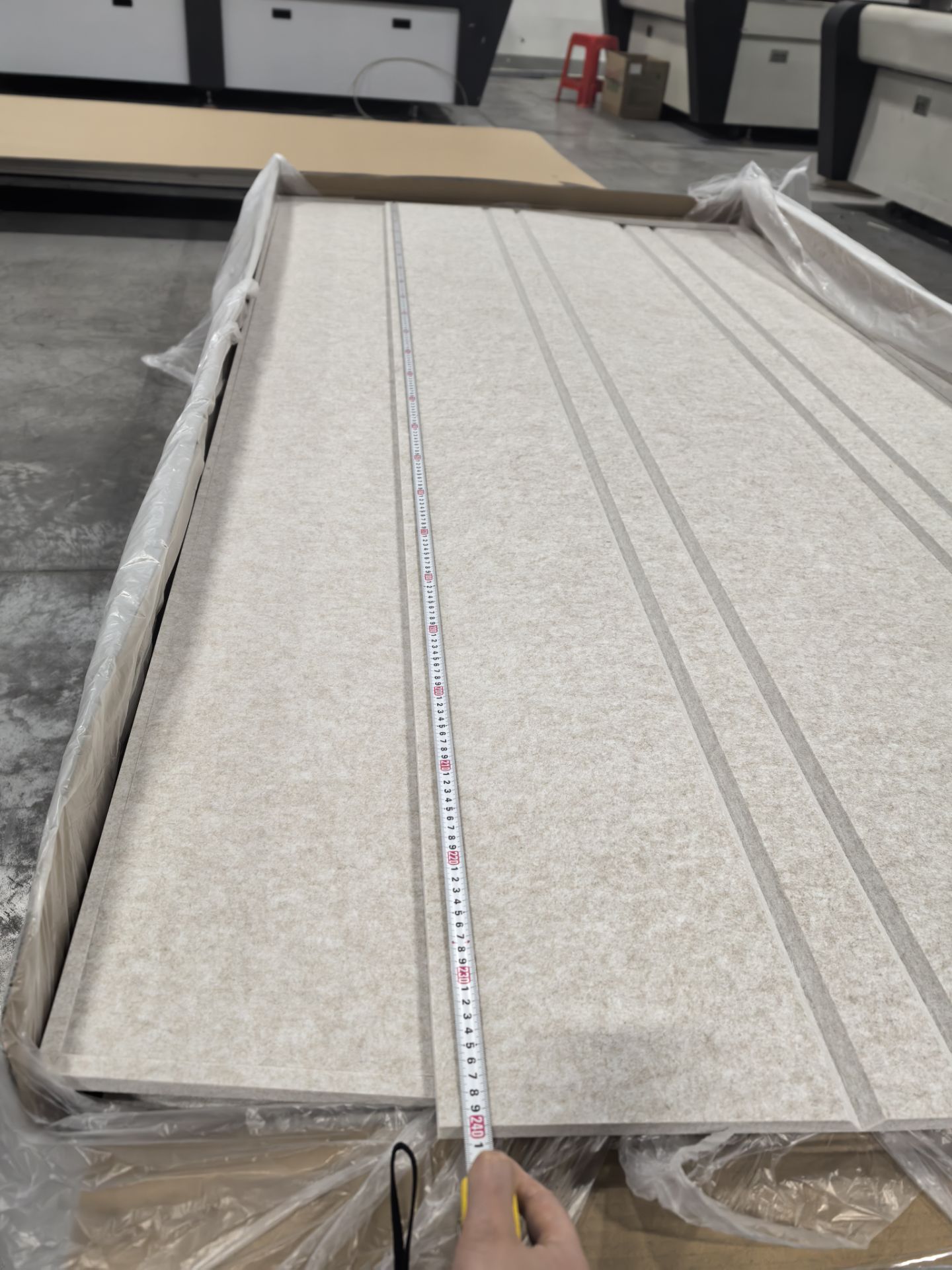
A Real Case: Same 2400 gsm, Different Result
The client initially experienced severe flaking with panels labeled 2400 gsm from another supplier.
Their technician suggested switching to 2500 gsm.
Instead of increasing density blindly, we did something simple.
We sent them 2400 gsm panels from our regular controlled production line.
They tested on their CNC V-groove machine and reported:
“The panels cut perfectly — no flakes, no burrs, cross-section smooth. Very satisfied.”
Same nominal GSM.
Completely different performance.
The difference was not density.
It was internal compactness and hardness stability.
Recommended Specification for CNC Processing
If your project includes deep machining, we suggest:
- Minimum real density: 2400 gsm
- Optimized compression production line
- Verified hardness
- Pre-production cutting test sample
Never confirm material only by price or GSM label.
Always test under real CNC conditions.
FAQ – PET Felt CNC Cutting
Q: Is 2500 gsm always better than 2400 gsm?
Not necessarily. If production process is weak, higher GSM may still flake.
Q: Why does flaking happen mainly in the middle layer?
Because internal fiber bonding is insufficient and compression is uneven.
Q: How can I verify real density?
Request actual weight per sheet and calculate gsm. Or perform random batch testing.
Q: Should I always test samples before bulk order?
Yes. Especially for V-groove and structural applications.
Final Advice for Furniture & Acoustic Brands
If you are investing in CNC equipment and skilled operators, your raw material must match your processing capability.
Material instability will:
- Increase rejection rate
- Slow down production
- Affect brand quality
- Increase long-term cost
Stable PET felt panels are not only about sound absorption.
They are about machining reliability.
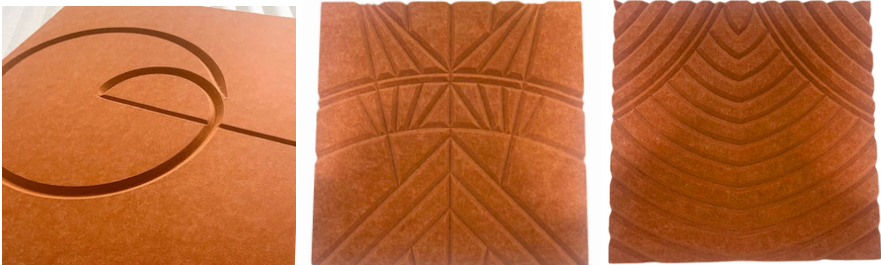
Need to Test Before Your Next Project?
If you are currently facing:
- Flaking during V-groove cutting
- Burrs after CNC processing
- Inconsistent panel quality
We can provide:
- 2400 gsm high-hardness test samples
- Batch-stable production supply
- Technical discussion based on your cutting parameters
Test it on your own machine.
Then decide.
Related pages: