Sep 2, 2026Services Overview
CNC Routing PET Felt: Mastering Complex Square Grooves
Not all CNC machines are the same. Learn the technical challenges of square grooves in PET felt, from tool paths to 4-side borders and clean finishing.
CNC Routing PET Felt: Why Your CAD Drawing Might Not Match the Final Product
In the world of acoustic PET felt panels, we often hear a common phrase from suppliers: "Yes, we have CNC machines, we can do any design."
But as a professional buyer or designer, you probably know that "having the machine"and "achieving the exact CAD detail"are two very different things.
Recently, we handled a challenging inquiry for further processed PET felt panels.
He didn't want the standard V-groove that you see everywhere.
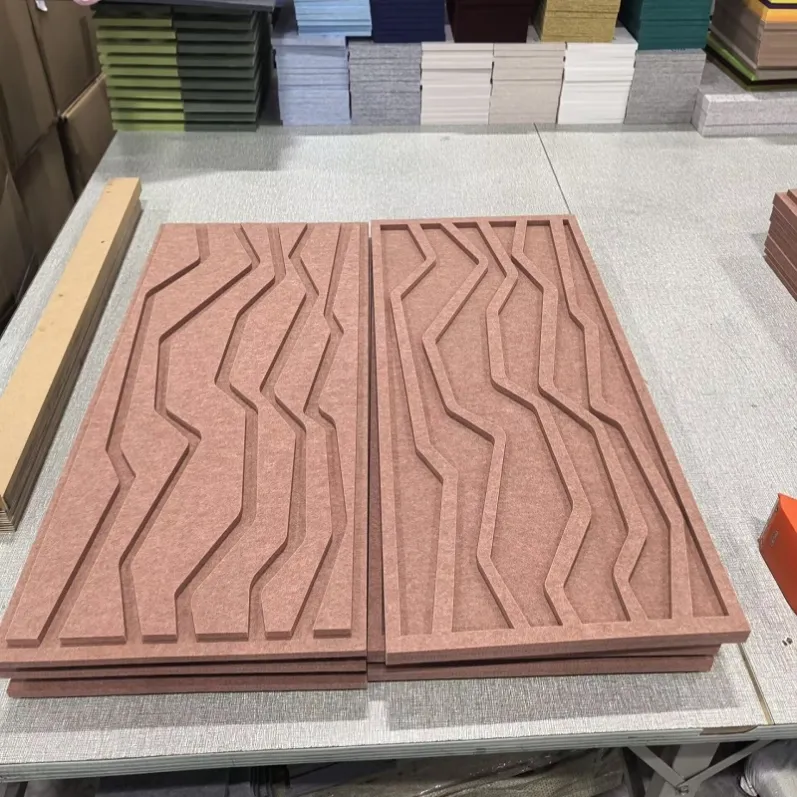
Instead, his design required a Square-Bottom Routed Groove—a flat, recessed channel with a specific depth.
More importantly, the drawing showed a 3mm uncut border on all four sides of each groove.
This sounds simple on a computer screen, but it revealed a huge gap in manufacturing capabilities across the industry.
The Reality of CNC Equipment in PET Felt Factories
Even though most PET felt factories today are equipped with CNC machines, their setups vary significantly.
Some are optimized for high-speed straight cutting (knives), while others are built for complex 3D routing.
When we analyzed this "Square Groove" project across different production lines, we saw three very different results.
Understanding these will help you choose the right partner for your next project.
1. The "Manual Removal" Method (Low Precision)
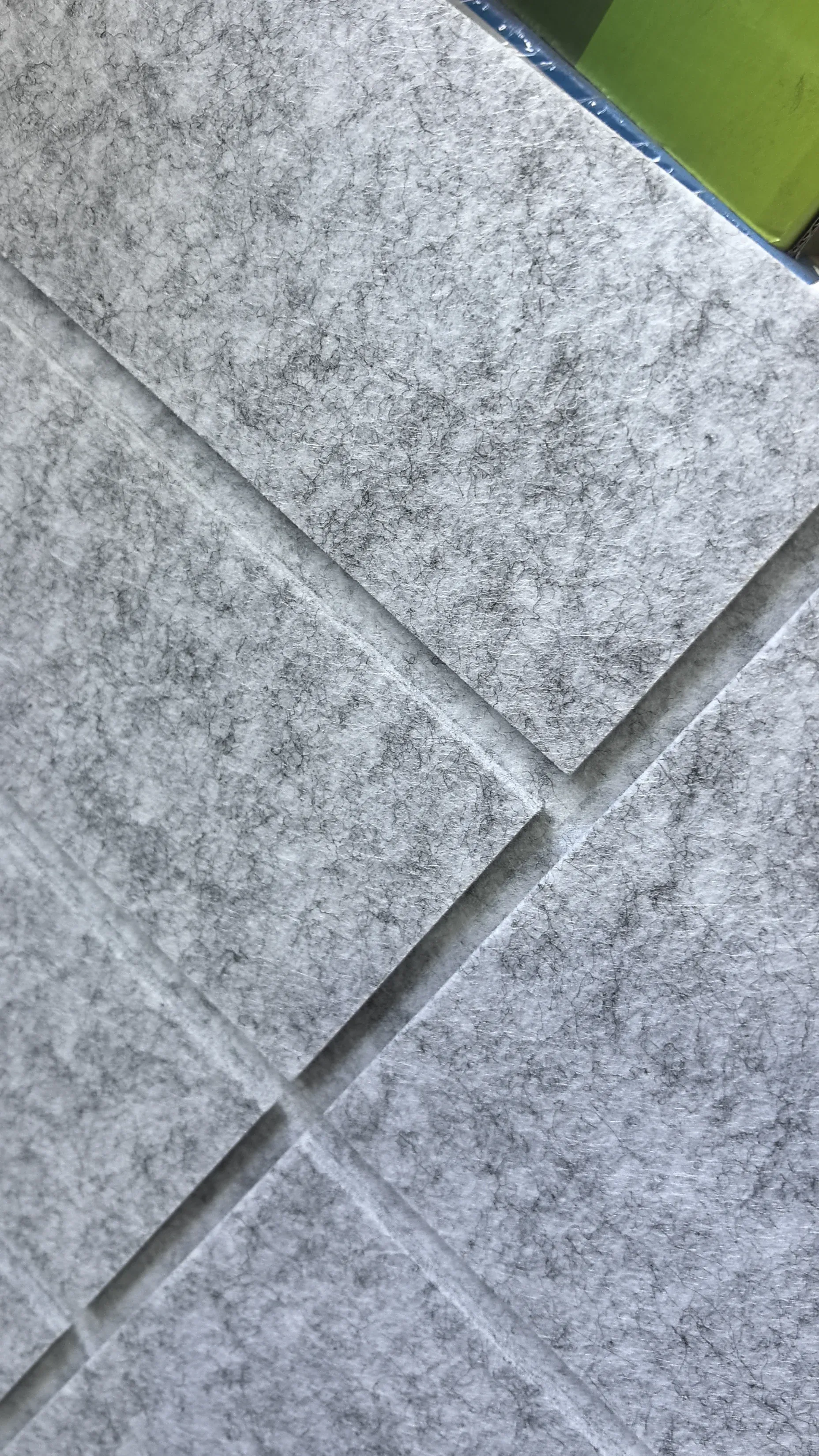
Some production setups are not designed for routing. To create a square groove, they use a standard CNC knife to cut the outlines and then have workers manually "peel off" the PET material inside.
The result?
The bottom of the groove is never smooth.
Because PET felt is a fibrous material, manual peeling leaves "fuzz," debris, and uneven depth.
For a high-end architectural project, this is usually unacceptable.
2. The "Through-Cut" Limitation (Tool Path Issues)
Other factories use routing bits but are limited by their machine’s software or axis movement. To create a groove, the tool must "enter" from one edge and "exit" from the other.
In this client's case, he needed the groove to stop 3mm before the edge on all four sides.
Many CNC machines could only achieve this on two sides. On the other two sides, the tool had to cut all the way to the end to complete its path.
If your design requires a "closed" frame look, this technical limitation ruins the aesthetic.
3. The Precision Routing Method (The Result We Aim For)
The highest level of processing involves a specialized CNC routing setup where the tool path is programmed to lift and drop with extreme precision.
By using a specific flat-bottom router bit and a calibrated "plunge" move, the machine can start and stop exactly 3mm from the edge on all four sides.
This leaves the borders intact and the bottom of the groove perfectly flat and clean, without any manual peeling or messy fibers.
Why Do These Differences Exist?
It is not just about the machine; it’s about the "Production Logic."
- Tooling:Not every factory stocks the specialized router bits needed for clean square-bottom cuts in fibrous PET.
- Speed vs. Quality:Routing is slower than knife cutting. Many factories avoid it because it "clogs up" their production schedule.
- Programming Expertise:Setting up a tool path that stops precisely 3mm from an edge requires a higher level of CNC programming than just following a line.
We don't just "take an order." We look at your CAD drawing from a manufacturing perspective. We know which production line in our facility is best suited for square grooves versus V-grooves, and we adjust our tool paths to match your exact border requirements.
What Should Buyers Check Before Ordering?
If your project involves custom CNC details, I suggest you don't just ask "Can you do it?"
Instead, ask these three technical questions:
- "Is this a routed groove or a knife-cut-and-peel groove?"(This tells you if the bottom will be clean).
- "Can you maintain an uncut border on all four sides of the groove?"(This tests their tool path capability).
- "Can I see a close-up photo of the groove corner?"(This reveals if they have "over-cut" issues).
Why This Matters for Your Project
Acoustic panels are often the "face" of an interior design. If the grooves are messy or the borders are inconsistent, it reflects poorly on the brand and the installer.
Whether you are designing furniture components, wall baffles, or custom ceiling clouds, the CNC detail is where the quality shows.
We believe in being honest about what can—and cannot—be done. If a design needs adjustment for better production stability, we will tell you before the first cut is made.
Final Thoughts
In the PET felt industry, different machines and different operators produce different results.
We have spent years fine-tuning our CNC routing process specifically for complex designs like square grooves and precision borders.
Do you have a CAD drawing that other suppliers said was "impossible" or "too difficult"?
Send it over. Let’s look at the tool paths together and find a way to make it a reality.
We are here to provide professional, clean, and reliable PET felt solutions for your most demanding projects.
More related pages
📩 Send us your project drawings or specifications, and we will respond with a clear quotation and production suggestion within 24 hours.
Email: info@hengmy.com