Aug 13, 2026Services Overview
Laser Cutting vs CNC Cutting PET Felt Panels: Which Method Is Better?
Laser and CNC cutting can both create custom PET felt panels, but they suit different designs. Compare cutting accuracy, speed, edge effects, engraving, thickness and production needs.
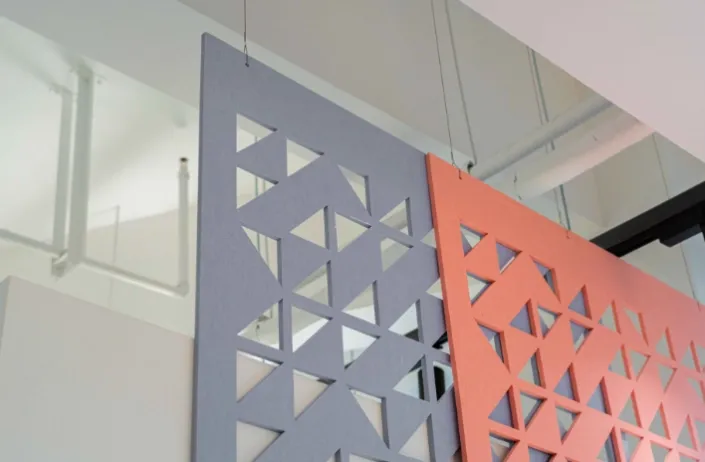
Laser Cutting vs CNC Cutting PET Felt Panels: Which Method Is Better?
When a designer or manufacturer wants to create a custom PET felt panel, CNC cutting and laser cutting are two methods that may come up.
At first, they can look quite similar.
Both can cut PET felt into different shapes and patterns, and both can be used for customized acoustic products.
But in actual production, they behave quite differently.
One customer may need fast cutting and a logo engraved directly on the panel. Another may care more about clean mechanical cutting and stable dimensions for a furniture component.
So, which method is better?
There is no single answer.
The better method depends on the design, the material, and what you expect from the finished PET felt panel.
CNC Cutting vs Laser Cutting: A Quick Comparison
| CNC Cutting | Laser Cutting |
|---|---|---|
Cutting method | Mechanical cutting | Heat-based cutting |
Cutting speed | Usually slower | Usually faster |
Cutting accuracy | Good for controlled mechanical cutting | Good for detailed cutting |
Edge effect | No thermal burn | May have heat/burn marks |
Odor during cutting | No thermal cutting odor | Odor may occur |
Surface engraving | Not the same as laser engraving | Can engrave logos, text and patterns |
Thicker PET felt | Can be suitable, depending on material and design | Needs careful testing |
Best suited for | Functional parts, custom shapes, furniture components | Fast cutting, detailed patterns, engraving |
This table is only a general comparison.
The actual result can change depending on PET felt density, thickness, color, design, machine settings, and production conditions.
1. How Does CNC Cutting Work on PET Felt?
CNC stands for Computer Numerical Control.
Instead of using heat, a CNC machine uses a cutting tool or blade to physically cut the PET felt.
This is important because PET felt is a fiber-based material.
The blade separates the material mechanically rather than melting it.
For many custom PET felt projects, this is useful because there is no thermal burning process at the cutting edge.
CNC cutting can be used for:
- straight cuts
- curved shapes
- holes
- slots
- geometric patterns
- custom furniture components
- acoustic decorative elements
For manufacturers, another important advantage is control.
Once the drawing and cutting process are confirmed, the same design can be repeated for production.
However, PET felt is not a rigid material like wood or acrylic. The material needs to be positioned properly during cutting, and the cutting condition needs to match the actual panel.
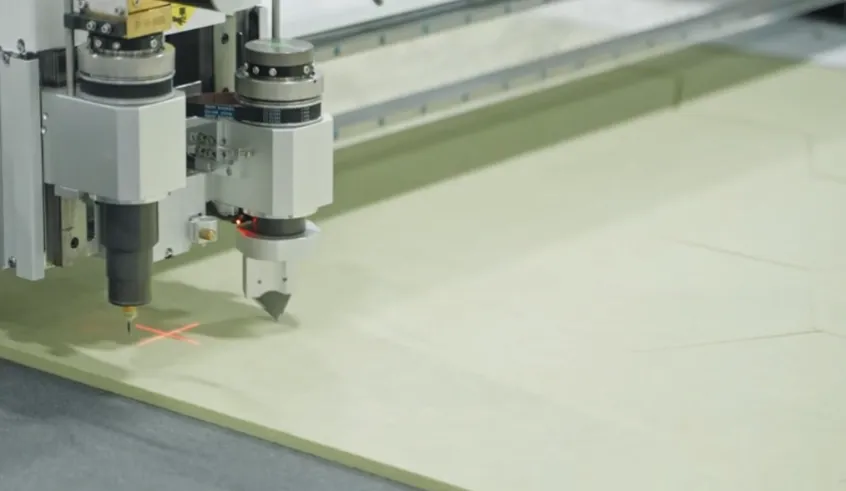
2. What Are the Advantages of CNC Cutting PET Felt?
More Suitable for Mechanical Cutting
Because CNC cutting does not rely on heat, there is no laser scorch effect on the cut edge.
This can be important when the edge of the PET felt component will remain visible.
For example, furniture manufacturers may use PET felt for:
- desk dividers
- cabinet components
- acoustic screens
- decorative furniture parts
In these applications, the appearance of the edge can be part of the final product.
Good Control for Custom Shapes
CNC cutting is also suitable when a project requires specific dimensions and controlled cutting paths.
For example, a manufacturer may provide a drawing showing:
- exact panel dimensions
- holes
- slots
- cut-outs
- repeated patterns
The supplier can then review the drawing and confirm whether the design is suitable for the selected PET felt material.
No Thermal Cutting Process
This is another practical difference.
With mechanical CNC cutting, there is no heat being used to melt the PET felt.
For customers who are concerned about burned edges or the odor associated with thermal cutting, this can be an important consideration.
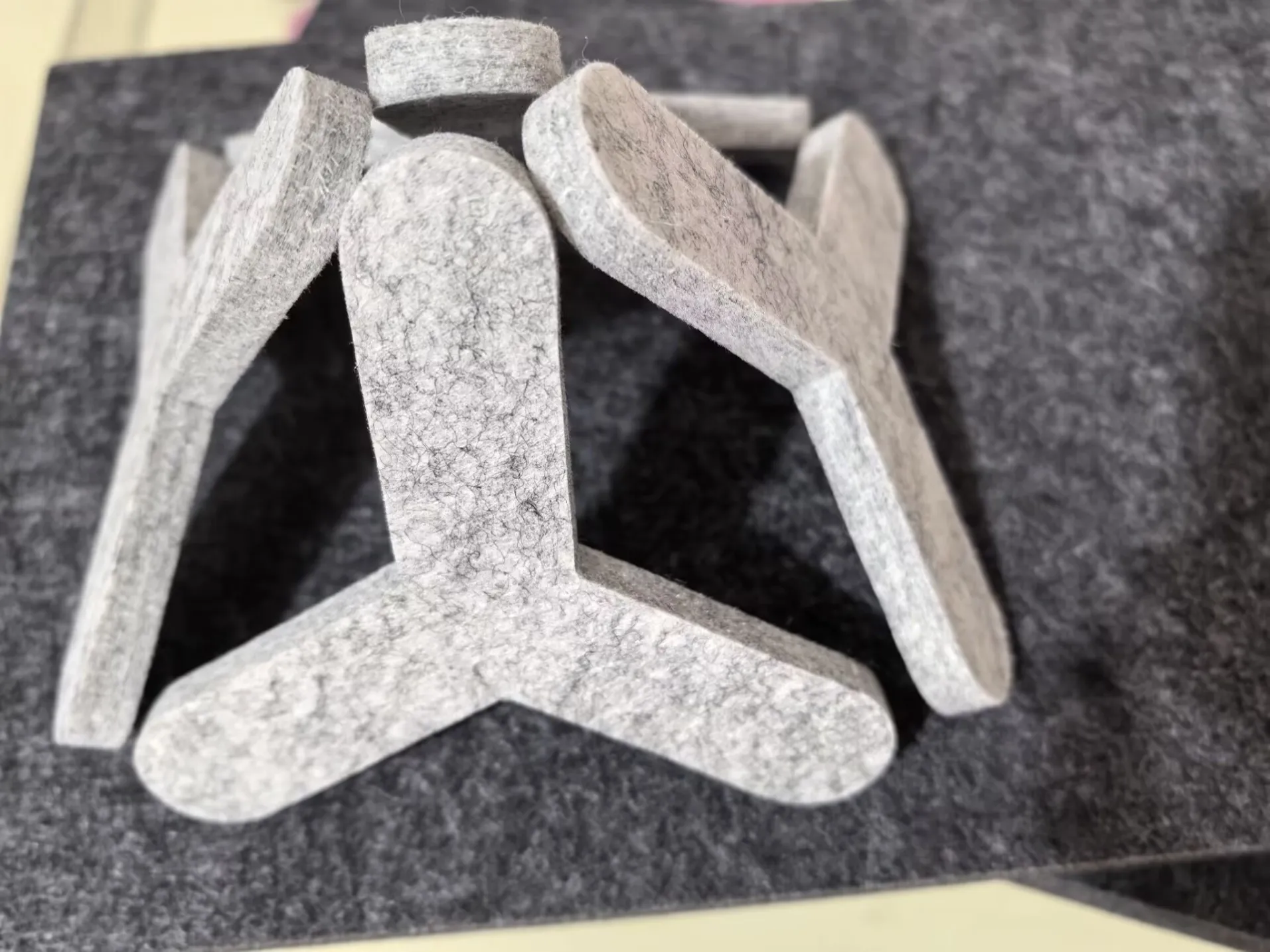
3. What Are the Advantages of Laser Cutting PET Felt?
Laser cutting works in a very different way.
A high-energy laser beam locally heats the material, causing it to melt or vaporize along the cutting path.
One obvious advantage is speed.
For some PET felt designs, laser cutting can process the pattern quickly.
This can be useful when the project contains many repeated shapes or detailed patterns.
But there is another advantage that is especially interesting for designers and acoustic brands:
laser engraving.
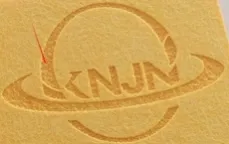
A laser machine can not only cut the PET felt, but also engrave on its surface.
This can be used for:
- logos
- letters
- patterns
- decorative graphics
- customized branding
For example, a company may want its logo engraved directly onto a PET acoustic panel.
This is an area where laser processing offers a different possibility from conventional CNC cutting.
4. The Main Issue With Laser Cutting: Heat
The biggest difference between the two methods is also one of the most important things to consider.
Laser cutting uses heat.
PET felt is a polyester fiber material, so the heat from the laser can affect the cut area.
Depending on the material and laser settings, you may see:
- darkened edges
- burn marks
- black scorch marks
- changes in the appearance of the cut edge
- odor during processing
The result can vary depending on:
- PET felt color
- density
- thickness
- laser power
- cutting speed
- machine settings
- design
This does not mean laser cutting cannot be used for PET felt.
It simply means that the finished effect should be tested before mass production.
If the cut edge will be highly visible in the final product, this point becomes even more important.
5. CNC Cutting and Laser Cutting Look Different at the Edge
This is something designers sometimes notice only after seeing the first sample.
With CNC cutting, the edge is produced by a blade.
With laser cutting, the edge is affected by heat.
Therefore, even when the two machines follow exactly the same drawing, the final appearance may be different.
For a decorative acoustic panel, this difference may not matter much if the edge is hidden.
But for a furniture component or exposed decorative part, it can matter.
This is why we normally recommend looking at the actual finished sample, not only the digital drawing.
A drawing can tell you whether the shape is correct.
A sample tells you what the material actually looks like after processing.
6. What About Cutting Accuracy?
Both CNC and laser machines can provide good cutting accuracy when properly set up.
But accuracy is not determined by the machine alone.
For PET felt, other factors also matter:
- material stability
- panel thickness
- density
- positioning
- cutting condition
- design details
CNC cutting can provide good control for projects where dimensional accuracy and repeatable mechanical cutting are important.
Laser cutting can also produce detailed patterns, especially when the design contains fine visual elements.
So instead of asking:
“Which machine has better accuracy?”
It is more useful to ask:
“Which cutting method gives the result I need for this particular PET felt design?”
7. What About Thicker PET Felt Panels?
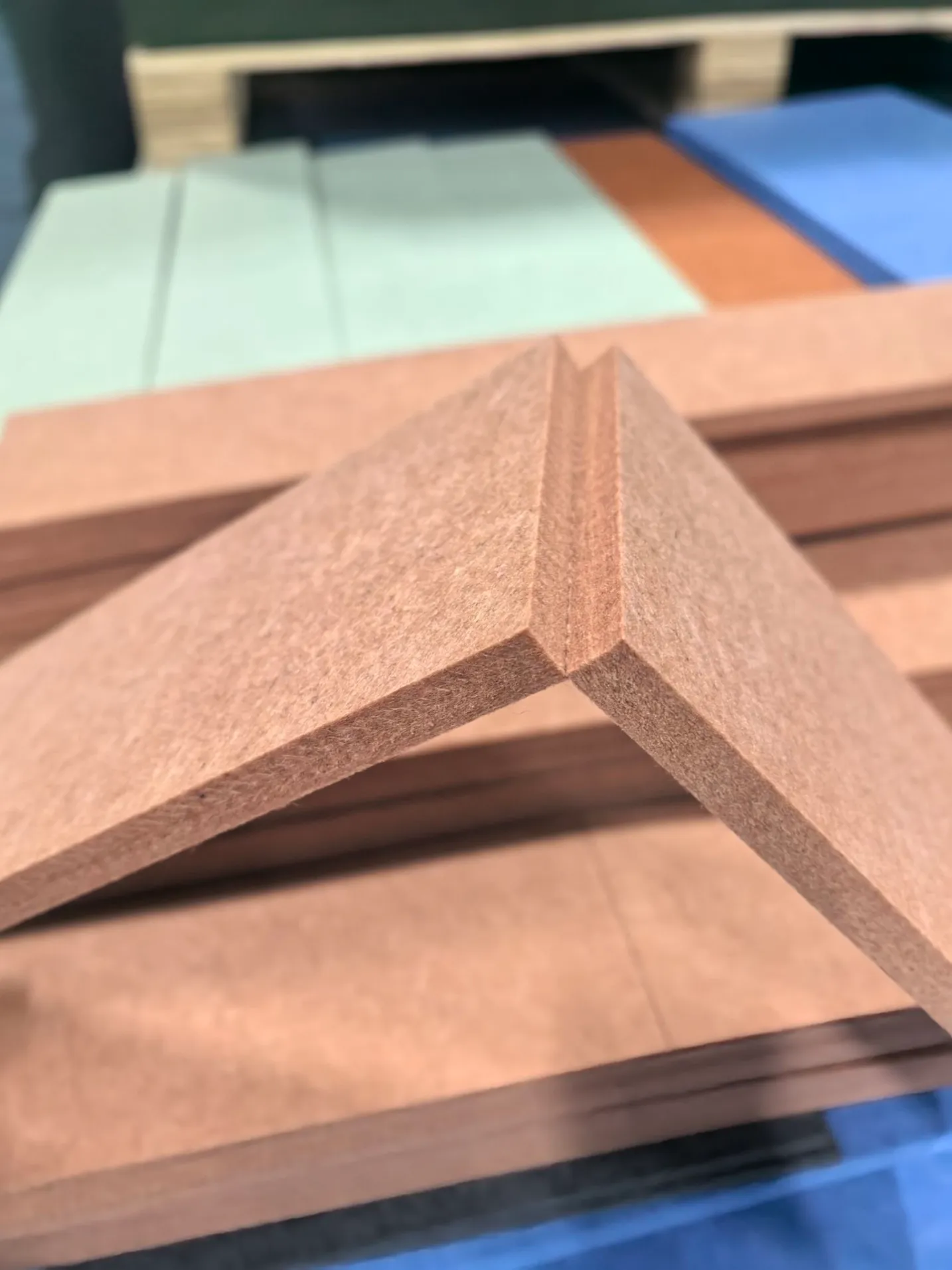
Thickness is another point that should be discussed before choosing the cutting method.
PET felt panels are available in different thicknesses, and thicker materials can behave differently during processing.
For a CNC project, the blade needs to pass through the selected material properly.
For laser cutting, the laser needs to deliver enough energy through the material without creating an unacceptable thermal effect.
Therefore, there should not be a simple rule such as:
“Laser is only for thin panels.”
or:
“CNC is always better for thick panels.”
The actual material, thickness, design and machine setup all need to be considered.
For a new or unusual specification, a test cut is the safer approach.
8. Which Method Is Better for Logos and Engraving?
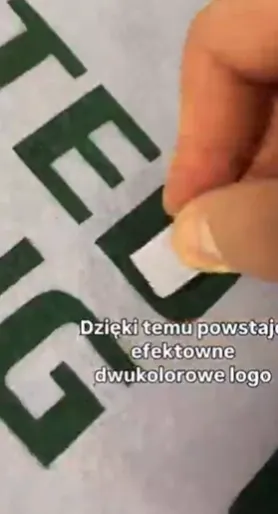
If the main requirement is to engrave a logo or pattern directly onto the surface of PET felt, laser processing has a clear advantage.
The laser can create the visual effect by changing the surface through heat.
This can be useful for:
- company logos
- brand names
- decorative patterns
- custom graphic designs
CNC cutting is different.
It is mainly a mechanical cutting process. It can create shapes, openings and cut patterns, but it does not provide the same type of surface engraving effect as a laser.
So if surface engraving is a key part of your design, laser may be the more suitable option.
9. Which Method Is Better for Furniture Manufacturers?
For furniture manufacturers, the decision is usually more complicated than simply choosing the fastest machine.
The finished PET felt component may need to:
- fit accurately into another part
- have clean visible edges
- maintain consistent dimensions
- be produced repeatedly
- meet a target production cost
For this type of project, CNC cutting can be a practical choice, especially when the design is mainly based on precise mechanical cutting.
For example, a PET felt desk divider may require a specific shape and several connection openings.
In this case, the cutting accuracy and edge condition may be more important than having a very fast cutting process.
But if the furniture design includes a visible logo or decorative engraving, laser processing may provide an additional option.
10. Which Method Is Better for Acoustic Brands?
For acoustic brands, the answer depends on the product design.
If you are developing:
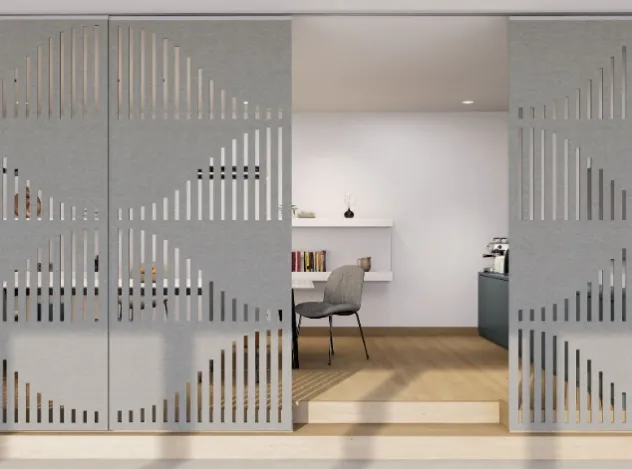
- decorative acoustic wall panels
- custom acoustic screens
- patterned acoustic panels
- branded acoustic products
both methods can have their place.
CNC may be more suitable when the focus is on cutting shapes and functional components.
Laser may be more attractive when the design needs detailed engraving or branding.
For a new product, it can also make sense to test both methods on the same PET felt material before deciding.
Sometimes the difference is much easier to understand when you can hold the two samples in your hand.
11. Don't Choose the Machine Before Looking at the Final Product
This is probably the most important point.
When discussing custom PET felt processing, we suggest starting with the final product rather than starting with the machine.
Ask:
What does the final product need to do?
Is it:
- an acoustic wall panel?
- a furniture component?
- a room divider?
- a decorative screen?
- a branded acoustic product?
Then ask:
What does the finished panel need to look like?
For example:
- Is the cut edge visible?
- Is engraving required?
- Are there small details?
- Are there many repeated pieces?
- Is production speed important?
- Is dimensional consistency important?
Only after these questions are clear can you decide which processing method makes more sense.
CNC or Laser: Which One Should You Choose?
There is no universal winner.
Choose CNC cutting when:
- mechanical cutting is the main requirement
- clean, controlled cut edges are important
- the design is mainly based on shapes, holes or slots
- the PET felt component will be used as a functional part
- you need repeated custom dimensions
Consider laser cutting when:
- fast processing is important
- the design contains detailed patterns
- surface engraving is required
- logos or branding need to be added directly to the PET felt
- the thermal effect on the edge is acceptable for the application
And for some projects, the best answer may only become clear after testing the actual PET felt panel.
A Simple Test Can Save a Lot of Trouble
For custom PET felt projects, we normally recommend making a sample before mass production when the cutting method or design is new.
You can compare:
- cutting edge
- surface appearance
- engraving effect
- dimensional accuracy
- odor during processing
- overall appearance
This is especially useful when the PET felt panel will become part of a finished furniture product or a branded acoustic product.
A small test at the beginning is usually much easier than changing the production method after a large quantity has already been processed.
Final Thoughts
CNC cutting and laser cutting are both useful methods for processing PET felt panels.
The question is not which machine is “better”.
The better question is:
Which method is better for your material, your design, and your final application?
CNC cutting can be a practical choice for controlled mechanical cutting and custom PET felt components.
Laser cutting can be useful when fast processing, detailed patterns, or surface engraving are important.
But the actual result depends on the PET felt material and processing conditions.
If you are developing a new PET felt product, we recommend testing the actual material and design before mass production.
Have a Custom PET Felt Cutting Project?
Not sure whether CNC or laser cutting is better for your PET felt design?
Send us your drawing, panel thickness, quantity, and final application.
We can review the cutting requirements with you and discuss which processing method may be more suitable for the project.
If you already have a drawing, feel free to send it to us. A simple discussion before production can often save unnecessary changes later.
📩 Send us your project drawings or specifications, and we will respond with a clear quotation and production suggestion within 24 hours.
Email: info@hengmy.com
More related pages: