Jun 26, 2026News & Insights
PET Felt Acoustic Panels Are Not Just Products: Solving Acoustic Problems in Real Spaces
PET felt acoustic panels are more than technical products—they solve real acoustic problems in offices, restaurants, schools, and public spaces.

PET Felt Acoustic Panels Are Not Just Products: Solving Acoustic Problems in Real Spaces
Why Acoustic Panels Are Never “Just Products”:
PET Felt Acoustic Panels Are Not Products. They Are Problem-Solving Tools.
One of the biggest mistakes in acoustic design
is thinking acoustic panels are only technical products.
Acoustic panels are often specified based on NRC values alone.
However, in real projects such as offices, restaurants, schools, and public spaces, acoustic performance depends on how the panel is used, installed, and experienced.
This article explains how to think beyond NRC when selecting PET felt acoustic panels for real spaces.
I learned this the hard way…
Acoustic panels are not just materials with numbers.
They are tools people use to fix problems in daily life.
Once you start seeing your product in real spaces — offices, cafés, classrooms —everything becomes easier to explain.
When I first started learning about PET felt acoustic panels, I thought it was simple.
Absorb sound.
Thicker panels absorb more.
Higher NRC = better performance.
Or so i thought.
That's what I believed — until I started talking to real clients.
One day, a designer asked me a very simple question: “Can this panel work in a restaurant?”
Another client asked:"can PET acoustic panel protect the wall from impact in sports studio?"
It's a mind frozen moment.
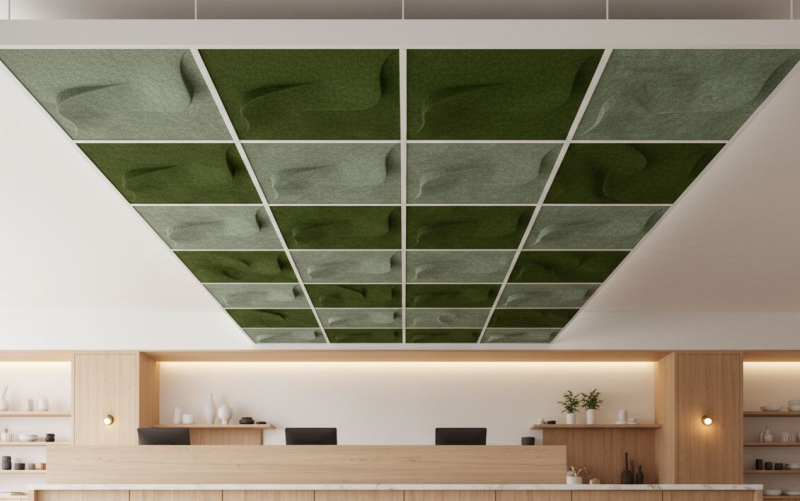
Products live in spaces, not in catalogs
An acoustic panel never exists alone.
It lives in an office, a school, a café, or a meeting room.
And each space has very different problems.
In open offices, people complain about:
- hearing every phone call
- no privacy
- too much echo
In restaurants, the problem is different:
- people need to talk comfortably
- the space should feel warm, not technical
- design matters as much as sound
So when we say “PET felt acoustic panels”,
the first question should not be: “what's the NRC?”
It should be: “Who is using it, and where?”
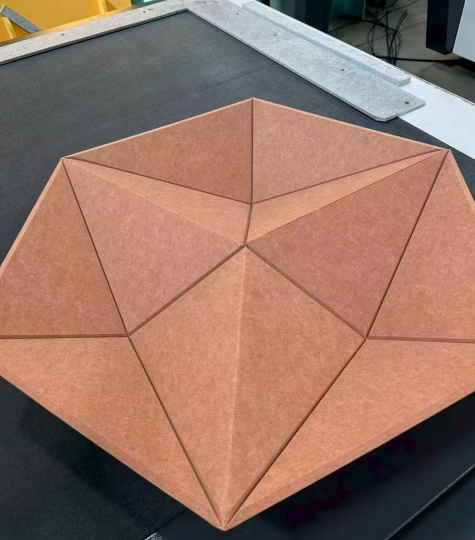
Same product, very different expectations
For an office project,clients care about:
- speech noise reduction
- clean and professional look
- easy installation
For an education project:
- safety
- no fiberglass
- stable performance over time
For a restaurant or hotel:
- texture
- color
- design freedom
The PET felt acoustic panels might be the same. But the solution is not.
If you work in architecture or interior design, you've probably seen projects where acoustic panels looked great on paper — but failed once people actually used in real spaces.
Real question from real life
We often hear this question:
“Can PET felt acoustic panels be used on the ceiling?”
"Are PET felt acoustic panels safe for schools and public spaces?"
“Can PET felt acoustic panels be installed on ceillings?”
This sounds simple.
But behind it,
the client is thinking about:
- weight
- safety
- long-term stability
- installation risk
in real spaces.
So instead of answering: “Yes, it can.”
We answer: “PET felt acoustic panels are widely used in ceiling applications, public areas, and integrate well into furnitures, due to their lightweight structure, dimensional stability, and low installation risk in public spaces.”

Selling panels vs solving problems
If not break down the product,
the conversation stays like this:
- Client: “What's the NRC?”
- answer: “0.85”
- Client: “Okay…”
But when you understand application:
- Client: “The space feels very noisy.”
- answer: “That's because speech frequencies are bouncing. PET felt panels absorb these frequencies well and help reduce echo and reverberation.”
Same product.
Completely different level.
Three Questions I Always Ask Before Recommending Acoustic Panels
1️⃣ Where will it be used?
2️⃣ Who will use the space?
3️⃣ What problem are we solving — noise, privacy, or comfort?
Understanding acoustic panels starts with understanding spaces.
If you’re planning a project and unsure which PET felt solution fits your application, this guide may help you ask the right questions before specifying materials.
Related Pages: