Jun 26, 2026News & Insights
Why Acoustic Panel Projects Fail: The Real Gap Between Design and Installation
Many acoustic panel problems do not come from the material itself. They come from the gap between design drawings and real installation conditions.
Why Acoustic Panel Projects Fail: The Real Gap Between Design and Installation
When people search for acoustic panels, they usually focus on product questions first:
- What is the thickness?
- What colors are available?
- What is the acoustic performance?
- Can it be customized?
- What is the price?
These are important questions.
But in many real projects, especially commercial interiors, office fit-out, and bespoke wall or ceiling systems, the biggest problem is often not the panel itself.
The real problem is the gap between design intent and installation reality.
For designers, contractors, and material distributors, this gap can directly affect project quality, site efficiency, and final cost.
In this article, we share a practical view of why acoustic panel projects run into problems, and what can be done earlier to reduce risk.
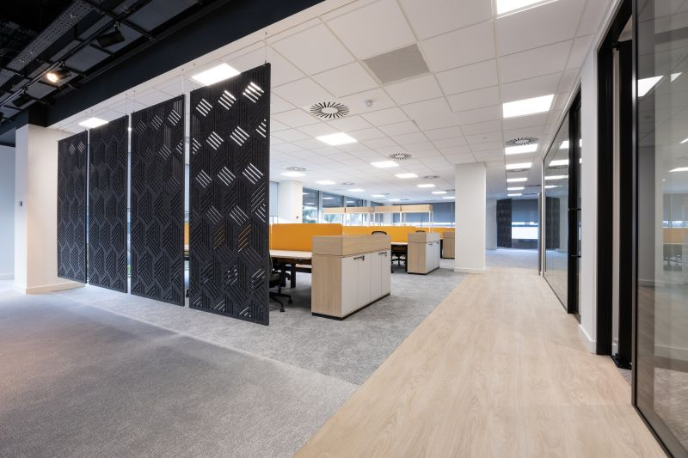
The Panel Is Often Not the Main Problem
A PET acoustic panel may be:
- manufactured correctly
- cut to approved size
- packed on time
- delivered according to schedule
And still, the project may become difficult during installation.
Why?
Because once the panel arrives on site, it is no longer just a product.
It becomes part of a much bigger system that includes:
- walls
- ceilings
- lighting
- services
- joinery
- edge details
- visual alignment
- other trades working in the same area
That is why many acoustic panel issues are actually project coordination issues.
Common Reasons Acoustic Panel Projects Fail on Site
- Drawings Do Not Fully Match Real Site Conditions
This is one of the most common problems in fit-out and commercial interior projects.
Even if drawings are approved, the actual site may show:
- dimensional variation
- uneven wall conditions
- shifted interfaces
- tolerance differences
For acoustic wall panels and decorative ceiling systems, even small changes can create visible fitting problems.
- Coordination Between Trades Is Not Fully Resolved
Acoustic panels do not exist alone.
They often need to align with:
- suspended ceilings
- lighting layouts
- HVAC outlets
- joinery details
- glazing lines
- furniture or partition systems
If these interfaces are not well coordinated, the installer may need to adjust the material on site, even when the product itself is made correctly.
- The Project Changes After Measurement
This is a very practical issue that many overseas suppliers and specifiers underestimate.
Between:
- site survey and
- final installation
the project may still change.
This can happen because of:
- site progress
- contractor sequencing
- revised details
- unexpected conditions
- late-stage design updates
When this happens, even custom-cut acoustic panels may no longer fit exactly as planned.
- Material Is Chosen Based on Product Only, Not Installation Practicality
This is another hidden issue.
Sometimes a material is selected because it looks good on sample boards, performs well acoustically, or fits the design concept.
But one more question is often missing:
How practical is this solution to install under real project conditions?
For example:
- Is full pre-cut a safe choice?
- Is some on-site flexibility needed?
- Is edge treatment realistic for the wall condition?
- Will the interface with joinery create problems later?
These questions matter because a good-looking specification does not always mean a smooth installation.
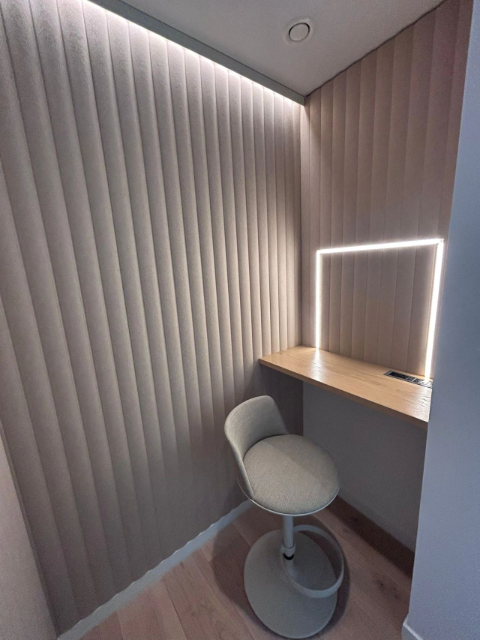
Why This Matters for Designers
For design companies, acoustic panel specification is not only about visual concept or acoustic performance.
It is also about buildability.
A design that looks clean on paper may still create:
- extra site cutting
- rework
- slower installation
- inconsistent final finish
That is why practical installation thinking should be considered early, especially for:
- bespoke wall panel layouts
- ceiling baffle systems
- feature acoustic walls
- integrated acoustic-furniture applications
Why This Matters for Distributors and Wholesalers
For interior material distributors and wholesalers, this issue is also very important.
Because once a project starts struggling, the material system often comes under pressure too.
Even if the product quality is fine, customers may start asking:
- Why is installation taking longer?
- Why is so much site adjustment needed?
- Why does the cut layout not match site condition?
- Why does rework happen?
This is why distributors benefit from working with suppliers who understand not only material production, but also project application.
A more practical supply recommendation can help reduce downstream complaints and improve repeat business.
How to Reduce the Gap Between Design and Installation
There is no perfect solution for every project.
But these steps usually help:
- Evaluate Project Stability Early
Ask whether dimensions and interfaces are stable enough for custom-cut supply.
- Match the Supply Format to the Project
Not every project needs the same approach.
Possible options include:
- full sheets
- project-cut panels
- semi-finished solutions
- hybrid supply methods
- Think About Buildability, Not Only Appearance
Good design and good installation should support each other.
- Leave Room for Practical Adjustment When Needed
In some projects, controlled flexibility is safer than pushing full precision too early.

Our View as a PET Acoustic Panel Manufacturer
As a China-based PET acoustic panel manufacturer, we work with different types of buyers, including:
- design companies
- acoustic solution providers
- fit-out contractors
- building material distributors
- interior wholesalers
One thing we have learned is this:
The best acoustic panel solution is not always the most complex one.
It is the one that best matches the real project condition.
Sometimes that means full-sheet flexibility.
Sometimes that means custom cut-to-size production.
Sometimes that means balancing factory preparation with site adaptation.
That is where real project value is created.

Conclusion
In many acoustic panel projects, the material itself is not the real reason things become difficult.
The real issue is often the distance between a clean drawing and a changing site.
For designers and distributors, understanding this earlier can help avoid delays, rework, and frustration later.
If you are sourcing PET acoustic panels for office, commercial, or interior decoration projects, it is worth discussing not only the panel design—but also the most practical supply method.
If you are reviewing an acoustic panel project and want to check whether:
- full sheets
- custom-cut panels
- or a mixed supply solution
would be more practical, feel free to contact us.
We can review your drawings or project concept and suggest a suitable supply approach based on real production and installation logic.
For more related pages:
Email: info@hengmy.com