Sep 8, 2026News & Insights
Non-Standard PET Felt Board Sizes: Why They Cost More — and When They Actually Make Sense
This article explains how production limits, shipping efficiency, and downstream nesting optimization drive size choices, helping designers understand real cost logic beyond the board itself.

Non-Standard PET Felt Board Sizes: Why They Cost More — and When They Actually Make Sense
In PET felt acoustic panels, most suppliers strongly recommend standard board sizes.
But in real projects, clients sometimes insist on non-standard dimensions — even when the price is significantly higher.
Why does this happen?
And more importantly, when does a non-standard size actually make sense?
This article explains the manufacturing, logistics, and nesting logic behind non-standard PET felt board sizes, based on real inquiries we receive.
Why 1220 × 2440 mm Is the Industry Standard
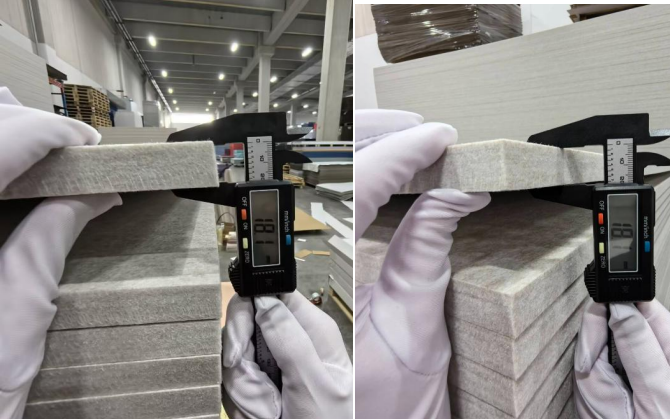
In PET felt acoustic panels, 1220 × 2440 mm (4’ × 8’) is the industry standard.
Not because of habit, but because production lines, CNC limits, and container shipping efficiency are all built around this size.
For factories like ours, this is also the core inventory size.
Raw PET felt sheets come off the production line at around 2440 mm width, and an inline cutting knife automatically splits the sheet into two 1220 mm panels.
- Minimal waste
- Stable material cost
- Predictable lead time
From manufacturing to logistics, this size is optimized at almost every stage.
So when clients ask for 62” × 122”, the first reaction is often: why?
Why Does 62” × 122” Keep Coming Up?
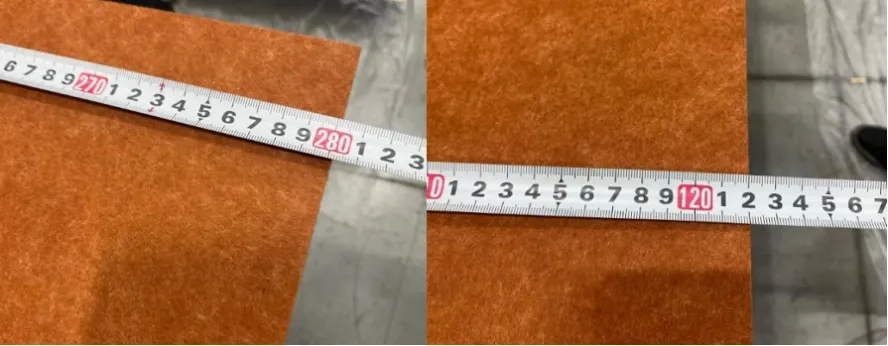
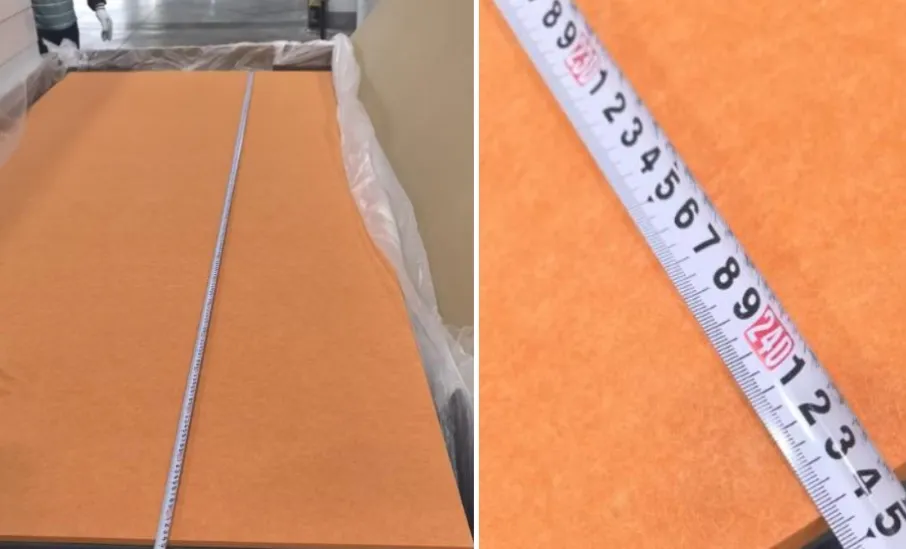
Recently, we’ve received multiple inquiries asking for 62” × 122” (approx. 1580 × 3100 mm) PET felt acoustic panels.
From the outside, this looks like a very unusual request.
Shipping challenges
Panels longer than 2440 mm already create problems:
- Poor container utilization
- More empty space inside the container
- Higher freight cost per sheet
In short, shipping efficiency drops sharply.
Production challenges
Our standard production line is designed around 2440 mm width.
Producing a 1580 mm wide board is not a simple adjustment.
It means:
- One side is cut to 1580 mm
- The remaining material becomes unusable offcut
- Significantly more waste than standard sizes
In practice, the material cost of a 62” × 122” PET felt board can be nearly 50% higher than a standard 1220 × 2440 mm board — before freight is even considered.
There is also a downstream limitation.
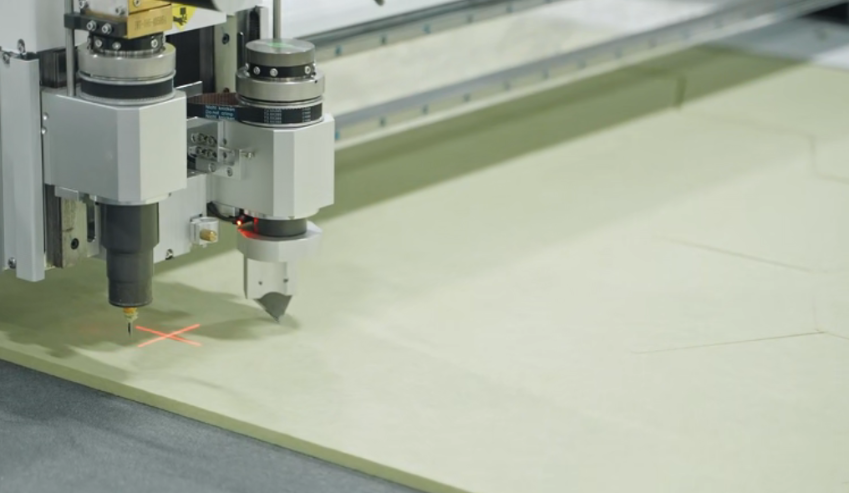
Most CNC routers used for PET felt processing have an effective working area of around 1300 × 2500 mm.
So even if the panel is produced, many processors cannot handle it efficiently.
From a factory point of view, this size feels… irrational.
Understanding Client Logic and Nesting Optimization
The reason only became clear after deeper conversations.
In certain local markets — especially where particleboard and MDF are widely used — 62” × 122” is actually a common production size, existing alongside 4’ × 8’.
For manufacturers producing:
- Table tops
- Cabinet panels
- Furniture components
their entire product design and nesting layout is optimized around this size.
Using 62” × 122” allows them to:
- Reduce cutting waste
- Improve nesting efficiency
- Maximize raw material utilization
- Lower total manufacturing cost
- Reduce scrap and disposal
This is classic manufacturing nesting optimization logic — not a random preference.
Once we understood this, the request made perfect sense.
The Real Lesson — “Standard” Is Relative
What looks inefficient in one part of the supply chain may be highly optimized in another.
- A factory thinks in production yield
- A logistics team thinks in container utilization
- A furniture manufacturer thinks in nesting efficiency
- A designer thinks in module proportions
There is no absolute “right” size — only trade-offs across the system.
Our role as a supplier is not to immediately say yes or no, but to help clients understand the cost logic behind each option and decide consciously.
Sometimes the standard size is still the best solution.
Sometimes a non-standard size makes sense — even if it looks inefficient at first glance.
Key Takeaways for Designers and Suppliers
Many inquiries fail not because of price, but because:
- The supplier doesn’t understand the client’s downstream logic
- Or the client doesn’t understand the upstream cost structure
Clear communication bridges that gap.
If you’re working with PET felt acoustic panels — or any sheet-based material — and evaluating non-standard sizes, it’s worth looking beyond the board itself and understanding how production, transport, and processing interact.
That’s often where the real cost is decided.
If you’re exploring custom PET felt board sizes or considering 3D thermoformed PET felt panels, feel free to contact us.
We’re always happy to discuss the cost logic behind different options.
More related pages:
📩 Send us your project drawings or specifications, and we will respond with a clear quotation and production suggestion within 24 hours.
Email: info@hengmy.com