Jun 26, 2026News & Insights
Can 24mm PET Acoustic Panels Achieve Class A Without Air Gap?
Can 24mm PET acoustic panels reach Class A sound absorption without air cavity? Learn realistic performance limits, NRC values, and practical solutions for achieving higher acoustic ratings.
Can 24mm PET Acoustic Panels Achieve Class A Without Air Gap?
One of our European clients recently asked:
“im looking for A-class sound absorbence plate in 1200x1200, mounted directly on gipswall. im asking for no airgap or insulation behind”
This is the common request.
and it creates a technical contradiction as well.
Here is the direct answer firstly:
In real projects, we often see confusion between laboratory test conditions and actual installation conditions.
We prefer to explain the physical limitation clearly before projects starts, ranther than over-promise performance to have clients orders.
So short answer: No —
in most cases, a 24mm PET acoustic panel installed directly on a solid wall cannot achieve Class A sound absorption without an air gap.
Here’s reasons you may wonder
Tested Performance of 24mm PET Panel (Direct Wall Mounting)
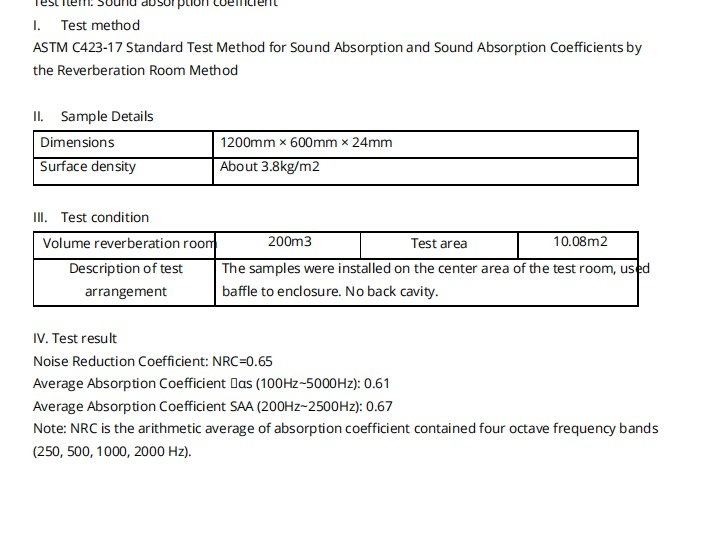
Based on ASTM C423 testing:
- Thickness: 24mm
- Installation: Direct mounting (no air cavity)
- NRC: 0.65
- SAA: 0.67
This performance level typically corresponds to Class C under EN ISO 11654 evaluation.
The limitation is mainly in low-frequency absorption.
When PET panels are mounted directly to rigid surfaces like concrete or drywall, low-frequency sound energy reflects instead of being absorbed effectively.
Why Class A Requires More Than Thickness
Class A sound absorption (αw ≥ 0.90) requires strong performance across multiple frequency bands, especially mid and low frequencies.
Increasing thickness alone:
- Improves mid-frequency absorption
- Has limited impact on low frequencies without cavity
For example:
- 24mm direct mount → NRC ≈ 0.65
- 40mm direct mount → NRC ≈ 0.75–0.80
Even at 40mm, reaching stable Class A is unlikely without structural support behind the panel.
In acoustic design, adding a small air gap often improves more than adding extra thickness.
Practical Solutions to Reach Higher Absorption
If your project requires Class A or higher performance, consider these options:
1. Add a Small Air Gap (Most Effective)
Even a 15–20mm air gap behind the 24mm panel can significantly improve low-frequency absorption.
This approach:
- Enhances overall NRC
- Increases chance of reaching Class A
- Requires minimal structural depth
2. Use Mineral Wool Backing
Wall → 10–20mm mineral wool → 24mm PET panel
This composite system improves absorption without large cavity construction.
3. Increase Panel Thickness
Using 30–40mm PET panels improves absorption, but typically achieves Class B rather than stable Class A without air gap.
4. Use System-Based Acoustic Design
Instead of relying only on wall panels, combine:
- Wall absorption
- Ceiling treatment
- Suspended acoustic elements
Room-level performance can reach Class A even if wall panels are directly mounted.
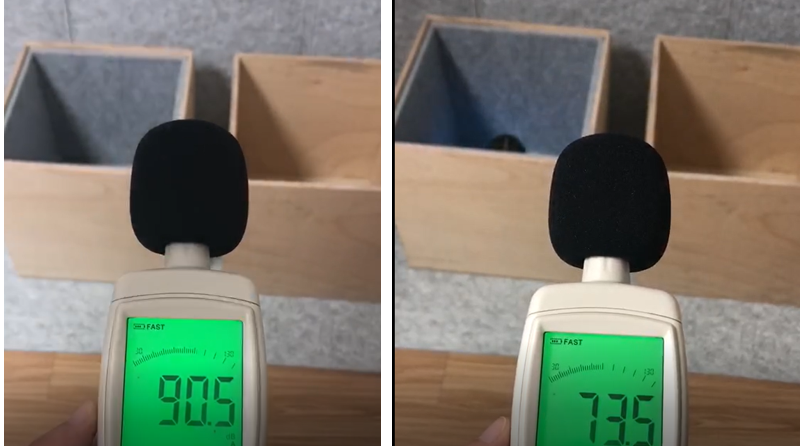
We have tested this configuration in reverberation room and also in commercial office projects.
More pages related
FAQ Section
Can PET acoustic panels achieve Class A without air gap?
In most cases, no. Without air cavity, 24mm PET panels typically achieve NRC around 0.65, corresponding to Class C performance.
Does increasing thickness improve sound absorption?
Yes, but mainly in mid frequencies. Without air gap, increasing thickness has limited effect on low-frequency absorption.
How much air gap is needed to improve performance?
Even 15–20mm air gap can significantly improve low-frequency absorption and help approach Class A.
Is mineral wool backing effective?
Yes. Adding 10–20mm mineral wool behind PET panels improves overall absorption without requiring large structural cavity.
Why do some Class A test reports include air gap?
Many laboratory tests for Class A are performed with 40mm air cavity. Installation conditions must match test conditions to achieve the same performance.
Conclusion
A 24mm PET acoustic panel installed directly on a solid wall typically achieves NRC around 0.65.
To reach Class A sound absorption, structural modification such as air gap or composite backing is usually required.
Sound absorption performance is not only about thickness — it is about installation structure.
Need Technical Advice for Your Project?
If you are working on a project that requires specific sound absorption performance, installation condition matters as much as material thickness.
Our acoustic team can help evaluate:
- Installation method
- Target performance level
- Suitable panel structure
- Feasibility of Class A requirement
Feel free to contact our acoustic support for technical discussion.
*Response within 24 hours.